Local Service Website Conversion Rate: What Is Normal?
What a normal conversion rate looks like for a local service website, why visitors leave without calling, and the fixes we make first on an owner's site.
Some months bring more visits than any other month this year. The phone stays quiet anyway.
That gap has a name and a number, and most owners have never looked at either one. Most advice on conversion rate comes from people who have never run a service site. This is what we see on owner’s sites, written plain.
A local service website usually converts 2 to 4 percent of visitors into calls or form fills. Below 2 percent is a fixable problem, not a verdict on your trade. Local visitors arrive mostly from a Google Business Profile or a map pack result, and they call within minutes of landing. If yours sits below that, start with why your website gets traffic but no calls.
TL;DR
- A normal conversion rate for a local service website runs about 2 to 4 percent.
- Under 2 percent is usually a fixable page problem, not a market problem.
- Calls are the main conversion in local service work, so counting only form fills hides most of your leads.
- Most visitors land from the map pack and decide fast, so the first screen does the heaviest lifting.
What counts as a conversion for a local service website?
A conversion is any visitor action that can end in a job. For a local service business, that usually means a phone call or a filled in quote form. Directions requests count too, since they often end in a visit.
That list is wider than most owners expect. These are the 4 actions worth counting on any service site:
- Phone calls, including a tap on the number from a phone.
- Click to call events from a Google Business Profile or a landing page.
- Quote form and contact form submissions.
- Direction requests and map taps inside Google Maps.
Only 1 of those 4 lands in your inbox. On the sites we audit, the form email often goes to an address nobody checks during the workday. The phone rings instead, and the owner watches the phone, not the form.
That split matters more than any benchmark. A call tracking number with dynamic number insertion puts a separate number on every visitor source.
A call from the map pack then stops looking identical to a call from a search result. You can fire GA4 events like call_click and generate_lead on the same tap and watch both in one report.
If you count form fills alone, you are reading a fraction of your own leads.
What is a normal conversion rate for a local service website?
Across industries, a typical website converts about 3 to 4 percent of visitors. A local service site sits inside that band. Once calls and forms are added together, a healthy rate for a cleaning crew or an HVAC shop lands between 2 and 4 percent.
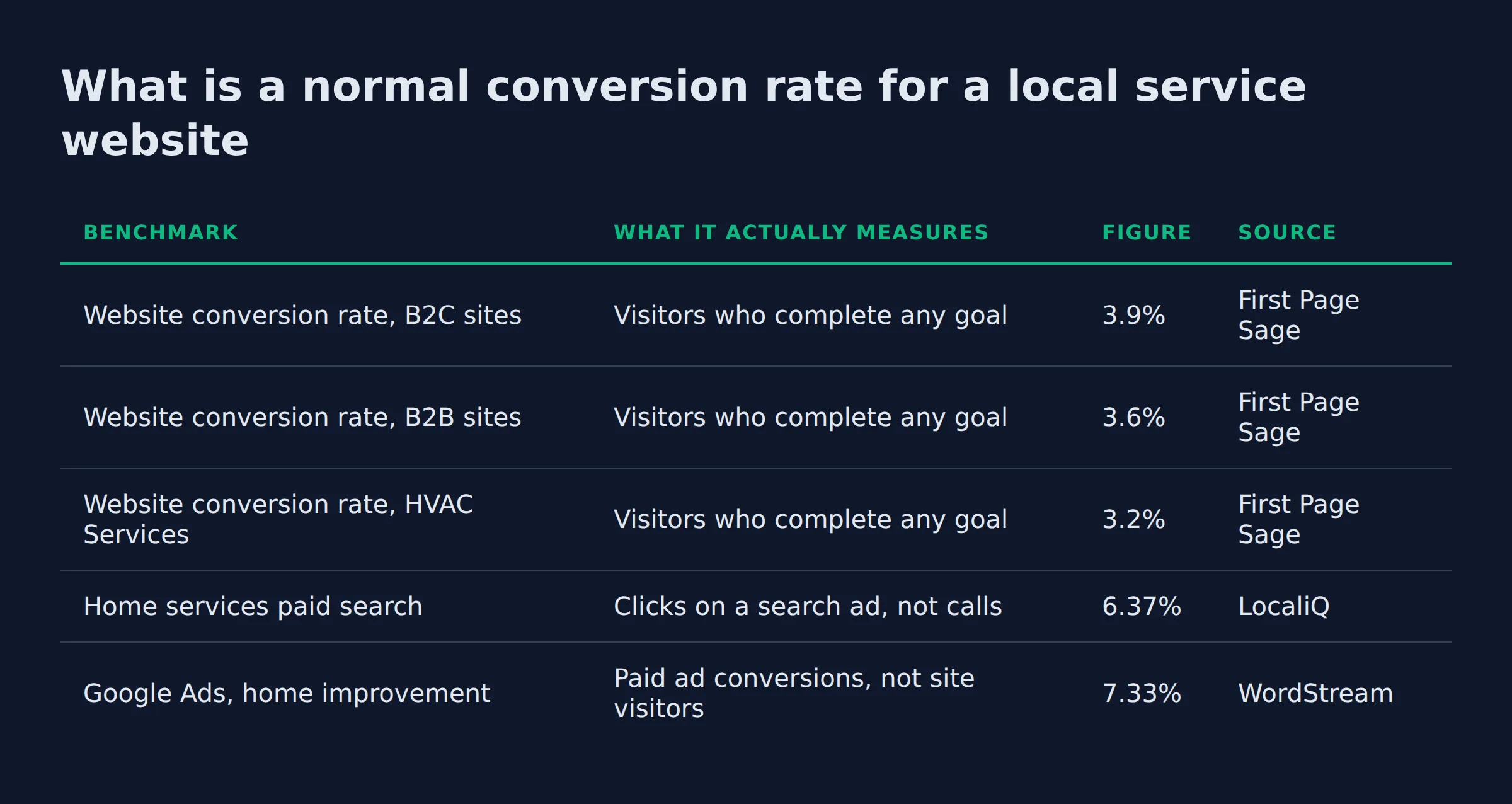
The catch is that published benchmarks measure different things. Here is what the numbers you keep seeing actually track.
| Benchmark | What it actually measures | Figure | Source |
|---|---|---|---|
| Website conversion rate, B2C sites | Visitors who complete any goal | 3.9% | First Page Sage |
| Website conversion rate, B2B sites | Visitors who complete any goal | 3.6% | First Page Sage |
| Website conversion rate, HVAC Services | Visitors who complete any goal | 3.2% | First Page Sage |
| Home services paid search | Clicks on a search ad, not calls | 6.37% | LocaliQ |
| Google Ads, home improvement | Paid ad conversions, not site visitors | 7.33% | WordStream |
Read the right-hand column closely. A 6.37 percent click through rate says nothing about how many of your visitors picked up the phone.
The average website visitor conversion rate figure owners quote most often comes from First Page Sage. It puts B2C sites at 3.9 percent and B2B sites at 3.6 percent, with HVAC Services named at 3.2 percent.
Its table also lists Solar at 2.2 percent and Healthcare at 3.5 percent. The report breaks the numbers down by first touch marketing channel as well.
Paid search tells a different story. LocaliQ’s home services search advertising benchmarks put average click through rate at 6.37 percent, up 13.95 percent year over year.
The same report puts cost per lead up 10.51 percent. Cleaning, maid and butler services sit at 9.01 percent in its subcategory table.
WordStream’s Google Ads conversion rate benchmarks list home improvement at 7.33 percent and dentists and dental services at 9.08 percent. Those are paid ad conversion rates. They are not website conversion rates, and swapping one for the other sends an owner after the wrong fix.
A paid click through rate is not your website conversion rate, and mixing the 2 sends you to the wrong page.
The conversion rate formula, in plain numbers
Conversions divided by visitors, times 100, is the whole formula. First Page Sage defines the average website visitor conversion rate as the share of total visitors who complete a chosen action. The math is that single line.
The work sits in both halves. One half is easy to inflate, and the other is easy to miss.
- Visitors: the sessions in Google Analytics 4, once you filter out bot traffic and your own visits.
- Conversions: every call, click to call, quote form, and contact form you can tie to a source.
If a visitor taps your number and you have no tracking number, that conversion vanishes. If they call and you have no source data, you cannot tell whether the map pack or a blog post sent them. That is the gap a call tracking number closes, and it is the first thing we set up before we touch a page.
One number, counted once: conversions divided by visitors. That beats every borrowed benchmark.
Why do local visitors behave differently from other visitors?
Local visitors arrive with a job they want done today. Most land from Google Maps or the map pack, read the profile, then call. They compare 2 or 3 nearby businesses instead of browsing a whole category, and that short list is the whole market they see.
Google’s own guidance on improve your local ranking on Google says local results weigh 3 things:
- Relevance, or how well your profile matches the search.
- Distance, or how far your business is from the searcher.
- Popularity, which Google calls prominence and ties to links and reviews.
A retail shopper rarely meets that mix. A plumber chasing a burst pipe searches at the moment of need. So does an electrician on a panel swap.
How fast do local visitors decide?
They decide in seconds, and mostly on the profile. They read the star rating and the newest review, check that the hours are listed, then tap the number. A site that loads slowly loses the tap before the visitor ever sees your work.
Two more differences show up in the data. Statcounter’s share of web traffic by device puts mobile at 49.36 percent against 49.11 percent for desktop worldwide. Your site has to work one thumb at a time.
Home service cost per lead is also up 10.51 percent year over year per LocaliQ. Organic visibility on the map pack keeps mattering more each year.
In local search, the decision usually happens on the profile, not on your homepage.
What do visitors check before they call?
Visitors check 2 things before they dial: how close you are and how recent your reviews are. Site speed is the gate that lets them stay. Reviews decide the most of the 3.
BrightLocal’s annual study of how consumers read reviews before choosing a local business found 97 percent read reviews online. It also found 41 percent always read reviews when browsing for businesses. Another 47 percent will not use a business with fewer than 20 reviews.
A Google Business Profile that lists real hours and real photos answers the question the visitor arrived with. A profile with neither sends the visitor back to the map. NAP consistency across your site and your directories supports that answer, and LocalBusiness schema markup tells Google which page is the business.
Does site speed change whether a visitor calls?
Yes, and it acts as a gate rather than a ranking trick. Core Web Vitals set 3 thresholds:
- Largest Contentful Paint within 2.5 seconds.
- Interaction to Next Paint at 200 milliseconds or less.
- Cumulative Layout Shift at 0.1 or less.
PageSpeed Insights checks all 3 in about a minute.
Which pages bring those visitors in is the other half of the job. We cover it in the pages on a local service website that actually rank. Keeping reviews coming is the third piece, and our guide to a review system that keeps producing reviews walks through it.
A review from this month beats 50 reviews from 2 years ago, because visitors read recency as a sign the business is still working.
What we see before we change anything
We open the site on a phone first. On most service sites, the phone number sits below the fold or only in the footer, so the visitor has to hunt for it.
That one detail explains a lot of flat months. The owner watches the sessions chart climb while the phone stays quiet. The first explanation they reach for is that the market went quiet.
Then we move the call button into the header and put a short quote form above the fold. The calls start tracking the traffic again.
The form tells its own story. We have opened contact pages where the form email was a personal address from a phone provider, and nobody had signed into it in months. The leads were sitting there the whole time.
Reviews get the same treatment. A profile with no new review in a year reads as a business that may have closed. A profile with a review from last week reads as a roofing company or a landscaping firm that is open and still good.
Moving the call button above the fold is the change owners feel fastest, and it costs nothing.
How do you find the step where visitors drop off?
Read your site as 4 steps, from the landing page through to the callback. Track each step, then fix the first one where the numbers fall.
Call tracking for a local service business starts with 1 number per source. Google Analytics 4 covers the rest. Mark the actions you care about as conversions, then watch the funnel from session to generate_lead inside the reports you already have.
What do you track first?
Start with calls and form fills over 30 days. Count them by source, then divide by visitors from that same source. A single blended rate hides the real story, because map pack traffic converts at a different pace than a broad search phrase.
The step that loses the most people is almost always the first screen, long before anyone reaches a form. Work in that order, from the top of the funnel down.
Fixing the bottom of the funnel first hides the real problem. That order is what we use inside our local SEO service, and it saves an owner a month of work.
Track the 4 steps for 30 days. The first step that drops tells you exactly where the fix goes.
Questions owners ask us most
How do you calculate the conversion rate of a local service website?
Divide your conversions by your visitors over the same period, then multiply by 100. Count both calls and form fills as conversions. A site with 400 visitors and 12 calls sits at 3 percent.
Should phone calls count as conversions, or only form fills?
Calls count, and for most local service businesses they are the larger share. Count forms as well, because plenty of visitors will not call during work hours. Tracking one of the 2 gives you a number that is wrong in the same direction every month.
Is 1 percent a bad conversion rate for a service business?
1 percent is low and worth fixing, but it is not a verdict on your trade. Check your traffic source mix before you rewrite pages. Traffic from a broad search phrase converts worse than traffic from the map pack, and a weak mix drags the rate down on its own.
How long after a fix should the conversion rate move?
Calls often move first, inside the first 2 weeks, because the fix sits on the page itself. The rate follows as the new traffic settles. Judge a change over 30 days, not 7, or you will react to noise.
Do Google reviews on your site change whether a visitor calls?
Reviews change the decision. BrightLocal’s survey found 97 percent of consumers read reviews online, and 47 percent skip a business with fewer than 20 reviews. A review from this month answers the doubt that stops the call.
Getting a straight read on your own numbers
If you want a straight read on where your local visibility stands, a 15-minute call covers it. We open your site on a phone and look at the profile side by side, then name the step where visitors are leaving. No pitch, only the read.
You can book that call here: https://link.localbizboost.com/widget/booking/lobOMW2RpbL2Vu9SblWG
Related: What Should a Local Service Homepage Say?
Related: How Google Ranks Local Businesses
Related: how to track leads from google for a local business