How to Show Up in ChatGPT for Local Businesses in 2026
ChatGPT suggests local businesses it can find and trust. Here is how a home-service owner gets named in ChatGPT, Google AI Overviews and Perplexity.
Someone in your city asks ChatGPT who to hire for a job you do every day. The answer names three shops. Yours is not one of them.
You ran the same search on Google last week and there they were again in the map. This time there is no page of results to scan and no obvious place to click. The answer is already out there, quoting someone else. That answer is usually Google’s AI Overview. Here is whether AI Overviews help local businesses.
How do you get your local business to show up in ChatGPT? ChatGPT names shops it can find and trust across the open web. Build out your Google Business Profile, and keep your name, address and phone number the same everywhere. Collect recent reviews, and publish service and city pages. Those same signals carry into Google AI Overviews and Perplexity.
Most advice on AI search comes from agencies pitching generative engine optimization. This is the plain version, for the owner with a van and a phone, built from the local SEO work we do for home-service shops.
TL;DR
- ChatGPT recommends local businesses it can find, understand and trust. Most of that evidence comes from your Google Business Profile, your reviews and your business details across the web.
- You can check your own visibility in about 10 minutes by asking ChatGPT, Gemini and Perplexity the questions your customers already ask.
- The first work is free. It is the same local SEO that helps you get found in Google Search and the map pack, also called the local pack.
What does it actually mean to show up in ChatGPT as a local business?
Showing up in ChatGPT means an AI answer names your business when someone asks for a service in your area. ChatGPT builds that answer from public pages it can read, and those are mostly the same sources Google already uses.
ChatGPT is an assistant with a search mode. ChatGPT Search goes out to the live web to answer a question. When a person asks for a roofer in Denver or a cleaner in Calgary, it reads pages and writes a reply. In December 2025 OpenAI added a local panel to those replies, so clicking a business name loads a small profile card, per Search Engine Roundtable.
The work has two labels. Answer engine optimization (AEO) targets the AI answer. Generative engine optimization (GEO) targets the model that writes it. For a local shop they are the same job.
When we run this check for an owner, the names that come back are rarely random. They are the shops that did the basic local visibility work, often without thinking about AI at all.
ChatGPT names your business when a public source it can read already says what you do and where you work.
How does ChatGPT decide which local businesses to recommend?
ChatGPT decides by reading what it can find about you across the web, then weighing how clear and consistent that information is. A complete profile, matching details and fresh reviews give it solid evidence. Gaps leave it guessing, and it guesses toward someone else.
ChatGPT keeps no private list of good local businesses. It retrieves pages, then answers from them. The local panel appears to lean on third-party data. One early observation is that the panel mirrors your Google Business Profile closely. A URL change in the profile showed up in ChatGPT almost at once, as Search Engine Roundtable reported.
The weighting underneath is one Google already published. Local results rest on three things Google calls relevance, distance and prominence. There is no way to request or pay for a better spot, according to Google’s guidance on how Google ranks local businesses.
Ask where an answer came from and you see the same shortlist.
- The shop’s own pages
- A directory profile
- A Reddit thread
- A YouTube review
- A Quora answer
- A “best of” roundup or listicle
Brand mentions on pages you did not write carry weight too, because they are independent votes. Even Wikipedia and Wikidata can matter, since AI systems read consistent entity facts. Owners almost never think to fix the directory profile or the roundup listing, and that is usually where the gap sits.
You feed ChatGPT the same evidence Google reads. Fix it once and both use it.
How do you check whether ChatGPT names your business today?
Ask ChatGPT, Gemini and Perplexity the exact questions a customer would ask about your service and your city. Write down which businesses get named and where you land. That gap is your starting point.
Here is the AI visibility audit we run for an owner, and you can copy it. Open each assistant and type the question a stranger would type, not your business name.
- “Best [service] in [city]”
- “Who should I call for [service] near [neighborhood]?”
- “[service] open now in [city]”
- “Is [business name] a good [service] company?”
For each answer, record three things. Did any business get named. Did your business get named. Which sources were cited. Screenshot the replies. A typical answer names three to five businesses, and the same few keep coming back.
The pattern we see most is a split. The owner’s business shows up when the question names it, because the model can find their site. It vanishes the moment the question has no brand in it, because the shop has no reviews strong enough to stand out. The second result is the one that matters, since most new customers arrive without knowing your name.
Run the branded question and the unbranded question. The unbranded one is the test that counts.
What makes a local business get recommended by ChatGPT?
ChatGPT recommends a local business when the web tells one clear, consistent, trusted story about it. A complete Google Business Profile, matching contact details, recent reviews and real service content build that story.
Seven things do most of the work, and none is exotic.
- A complete Google Business Profile, with every category, service, hour and photo filled in.
- The same name, address and phone number on your site, Google and every directory. Google spells out the rules in its business guidelines.
- Recent Google reviews. Age matters as much as the count.
- One page per service, and one per city or service area you cover.
- Consistent listings on the directories customers use, such as Yelp and the Better Business Bureau.
- The same details on the industry directories your trade relies on.
LocalBusinessstructured data on your site, the markup that tells Google what kind of business you are, per Google’s structured data guide.
That list is a set of public signals, and it is what people mean by NAP consistency and local citations. The one owners overlook is the boring consistency one. A website says one thing, an old listing says another, and a directory has a phone number from years ago.
An AI reading all three has to pick, and it often picks a competitor with cleaner data. Real first-hand detail also earns trust, which is the experience in Google’s E-E-A-T quality framework, per its people-first content guidance.
Clean, matching details across the web are worth more than any single clever page you write.
How does local SEO for AI search work in practice?
Local SEO for AI search is the same ground game you run for Google, aimed at a newer reader. Finish the profile, keep details consistent, publish service and city pages, and earn real reviews. Do it once and it feeds every surface.
You do not maintain two campaigns. Google states that AI Overviews and AI Mode run on the ordinary Search index. They need no extra requirements or special optimization, per Google Search Central on AI features and your website.
A page that earns its place in Search can earn its place in the AI answer too. One technical baseline stays. If a page is not indexed and crawlable, it cannot be a supporting link in either place.
There is a small, optional file some teams add. The llms.txt proposal puts a plain markdown file at your site root that summarizes the site for language models. It is a nice-to-have and not a ranking lever, and we treat it that way.
What moves the needle is the local work. When we onboard a shop that is invisible in ChatGPT, the first change is the Google Business Profile. Every AI answer about a local business leans on it. The second is aligning the name, address and phone number across the directories the owner already has, which often takes longer. Old listings hide in places no one remembers.
If you would rather hand the checklist to someone, our local SEO service does it. That includes setting up your Google Business Profile correctly.
One local SEO effort feeds Google Search, the map pack, AI Overviews and ChatGPT. You maintain it once.
How do you show up in AI search with no marketing budget?
You show up in AI search with no budget by finishing the free work first. Claim and complete your Google Business Profile. Fix your details everywhere, ask every happy customer for a review, and write pages for each service and city.
Everything that gets a shop named in an AI answer is owner work before it is paid work. The order matters more than the speed.
- Complete the Google Business Profile before you touch anything else.
- Fix the name, address and phone number on every listing.
- Ask for a review at the end of every job.
- Write one page per service and one per city.
If you do this well, you can skip paid help for a while. Most owners stall on reviews, because asking feels awkward and the follow-up is missing. The fix is a simple habit.
Ask for a review the same way you collect payment, at the end of every job. Getting more Google reviews for a service business walks through the ask that works. Recency carries as much weight as the total, so a steady trickle of recent reviews beats a large pile from years ago.
The free moves come first, and for most owners they are enough to get named.
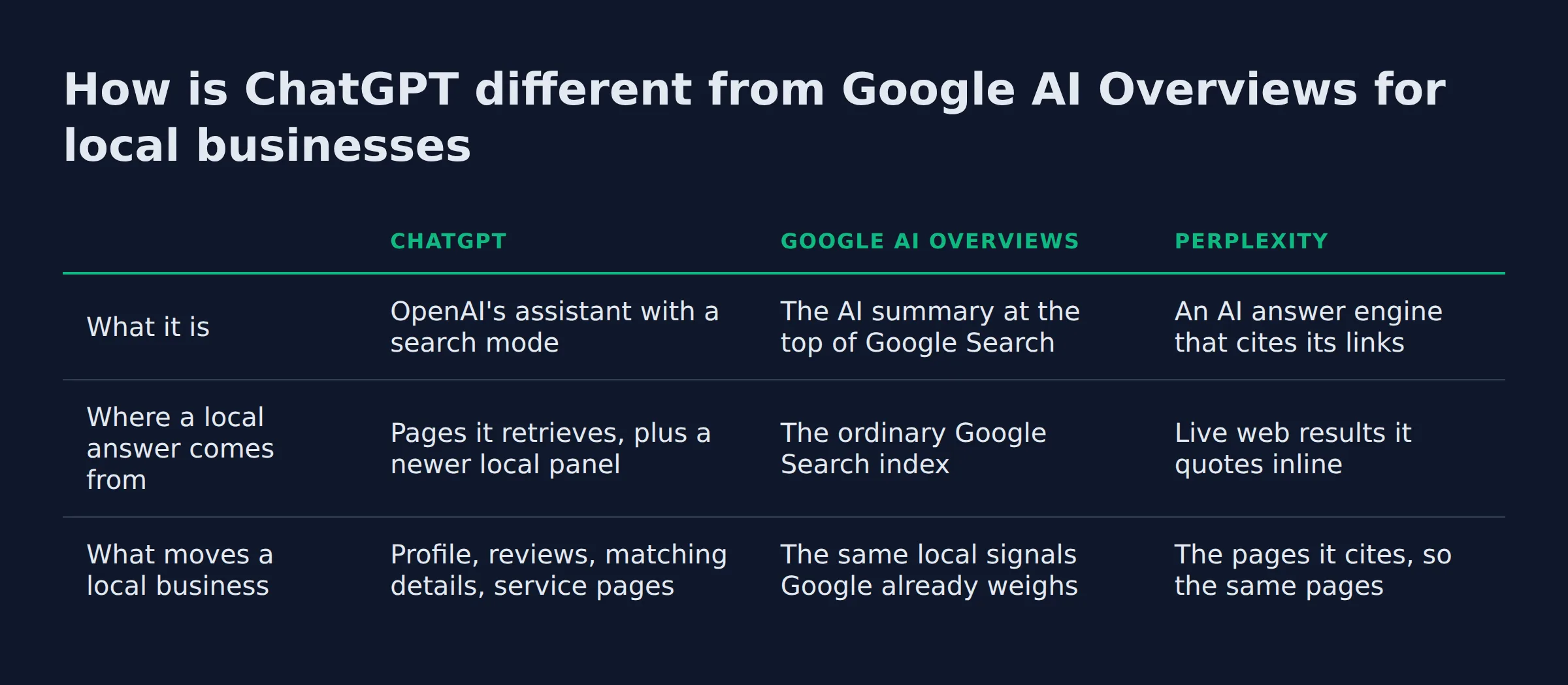
How is ChatGPT different from Google AI Overviews for local businesses?
ChatGPT answers from sources it retrieves across the web and shows a local panel for local questions. Google AI Overviews run on the ordinary Search index. Both lean on the same signals, so the work that helps in one helps in the other.
They are different readers with the same diet. One lives inside Google, the other inside OpenAI’s assistant. Here is the head-to-head.
| ChatGPT | Google AI Overviews | Perplexity | |
|---|---|---|---|
| What it is | OpenAI’s assistant with a search mode | The AI summary at the top of Google Search | An AI answer engine that cites its links |
| Where a local answer comes from | Pages it retrieves, plus a newer local panel | The ordinary Google Search index | Live web results it quotes inline |
| What moves a local business | Profile, reviews, matching details, service pages | The same local signals Google already weighs | The pages it cites, so the same pages |
Two differences matter to an owner. First, ChatGPT is a separate destination, so a customer who never opens Google can still find you there. Second, Google says AI Overviews need no special optimization, only a normal, indexed, helpful page, per Google Search Central. Google AI Mode works the same way inside Search.
ChatGPT publishes no creator checklist, so there is nothing to install. Microsoft Copilot runs on Bing’s index and directory. A claimed Bing Places listing and a clean Apple Maps entry are part of the standard setup. Google Search Console fills in the last piece. It shows the queries you already get found for, and those are the exact prompts to test.
Some owners ask about ChatGPT Ads. A paid placement sits near the answer, and the recommendation itself is still earned through public signals, the same as Google’s local ranking.
ChatGPT and Google AI Overviews want the same evidence. One finish line covers both.
Related: how to rank a local business in AI search
Related: How Google Ranks Local Businesses
Related: What Should a Local Service Homepage Say?
FAQ
Can I use ChatGPT for my business?
Yes. You can use ChatGPT to draft service descriptions, answer customer questions and test your own pages. The separate task is getting ChatGPT to name your business. That depends on the public information about you, not on how you use the tool.
Can I do local SEO myself?
Yes, most of it. Completing a Google Business Profile, asking for reviews and keeping your details consistent are owner tasks that need time, not tools. What stalls a busy owner is the follow-through and the cleanup across old listings.
Do I need a website for ChatGPT to recommend my business?
A website helps, and it is not strictly required. ChatGPT reads whatever public sources it can find about you, including directory profiles. A clear site with your services and city gives it the strongest source to quote, so most shops should have one.
Do I have to pay ChatGPT or OpenAI to be recommended?
No. You cannot pay ChatGPT or OpenAI for a recommendation. There is no way to pay Google for a better local ranking either, per Google’s guidance. A business that shows up got there through public signals, not spend.
Is ChatGPT showing my competitors instead of my business?
Sometimes, and the cause is usually thin public information. When competitors have complete profiles, recent reviews and matching details, the model has more to quote about them. Closing those gaps is how you get into the answer.
How long does it take to show up in ChatGPT?
There is no fixed timeline, and anyone promising one is guessing. Profile fixes and listing cleanups can surface in weeks. Review momentum and new service pages build more slowly. The direction is what matters, and it moves once your public information changes.
If you want a straight read on where your local visibility stands, a 15-minute call covers it. We run the same AI visibility check on your business and show you what is missing.