How to Rank a Local Business in AI Search (2026)
AI search names a business, not a link. Here is how a home-service owner gets their local business cited by ChatGPT, Google AI Overviews and Perplexity.
A homeowner opens ChatGPT and types “gutter cleaning near me”. Three names come back. The fourth best shop in town never hears about it.
Local search moved. The answer now arrives before anyone clicks a link. The shop that gets named gets the call.
How do you rank a local business in AI search? You get named in the answer. AI engines pull from your Google Business Profile and your website. They also lean on your reviews and the directories they trust. Keep your name, address and phone number identical everywhere. Give each service its own page. Then keep your reviews fresh.
Most advice on ranking in AI search is theory from people who have never run it for a one-van shop. This is the plain version, in the order we do the work.
The short version:
- AI search names a business instead of linking to it. You compete for a mention now.
- Three signals run the whole thing: relevance, distance and prominence.
- Fix your Google Business Profile, your contact details and your reviews first.
- You can check where you stand for free, using the engines themselves.
What does ranking mean for a local business when AI writes the answer?
Ranking in AI search means your business gets named inside the written answer. The engine writes a short reply and lists the sources behind it. You want your name in that text and in those sources.
A short answer now does the work a blue link used to do. If the answer carries your name, the homeowner may never need to visit your site.
That is fine. A cleaner in a mid-size city loses the click and still wins the job, because the first sentence said who to call.
Google says its AI Overviews and AI Mode run on the same Search index as normal results. There are no extra requirements and no switch to flip, per Google’s AI features documentation. The page you already have can be quoted tomorrow.
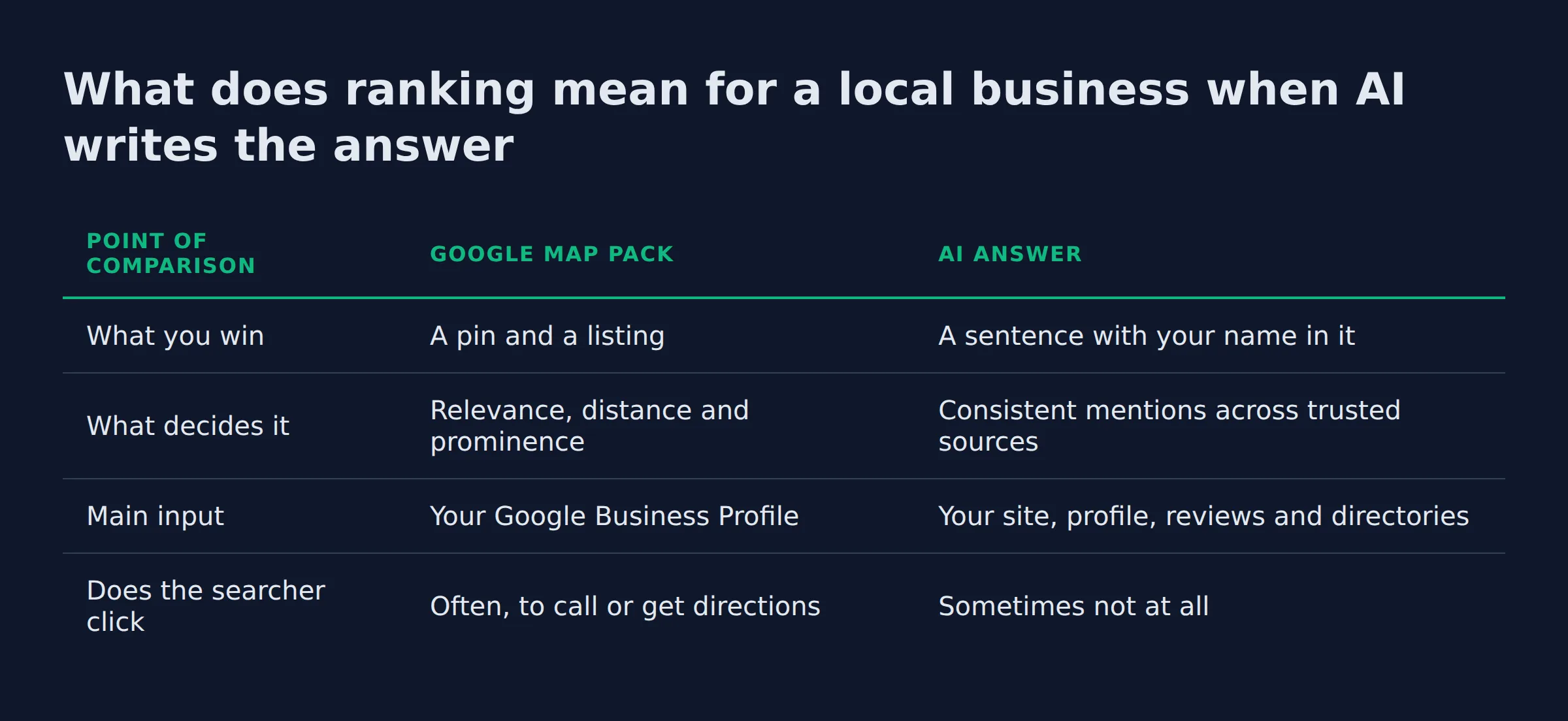
Here is how the 2 main channels line up now.
| Point of comparison | Google map pack | AI answer |
|---|---|---|
| What you win | A pin and a listing | A sentence with your name in it |
| What decides it | Relevance, distance and prominence | Consistent mentions across trusted sources |
| Main input | Your Google Business Profile | Your site, profile, reviews and directories |
| Does the searcher click | Often, to call or get directions | Sometimes not at all |
Google’s help page on how Google ranks local businesses names the 3 factors in that middle row. Relevance, distance and prominence decide the map pack. You cannot pay for a better local ranking, and you cannot request one.
Prove you are one real, active business in one place. That proof works for both channels.
How do AI engines decide which local businesses to name?
AI engines name businesses that show up across several sources they trust. They look for a clear link between one business, one service and one city. Repeated mentions in your profile, site, reviews and directories carry the most weight.
The engines do not rank your website alone. They assemble an answer from everything public about you. When those sources disagree, the answer turns vague or names someone else.
A roofer with a strong site and a half-built profile gets skipped. A plumber with a plain site and a full profile gets named. The profile usually decides it.
When your details match across your profile, your site and the directories, the engine has nothing left to doubt.
The sources AI keeps quoting for your city
Ask four engines the same local question and a small set of sources repeats. Your Google Business Profile and a directory page do most of the work. So does one local article or roundup.
We see this every time we audit a shop that is invisible in AI search. The profile is half-built. One directory entry carries an old phone number. A “best of” list in town names a competitor. No one has touched any of it in years.
That list of sources is the real target. A new website comes later.
Fixing the profiles and listings you already have often moves AI visibility faster than any new page.
Where does ChatGPT get the local businesses it recommends?
ChatGPT Search reads pages it can find and open, then cites the ones it used. For a local business that means your website and your directory profiles. It also means any recent third-party mention. If it cannot read you, it will not name you.
OpenAI’s own help page describes how ChatGPT search pulls from the live web and links the sources it used. Those are the same public pages your customers can see.
The pages it leans on are ordinary:
- Your own website and its service pages
- Directory profiles such as Yelp, the Better Business Bureau and Apple Maps
- Trade and industry directories for your niche
- Recent local coverage or a “best of” roundup
- Forum threads on Reddit and Quora that mention local shops
Every one of those pages can carry your name or the wrong one. Fix the wrong ones first.
For a fuller walkthrough of one engine, see our post on showing up in ChatGPT as a local business.
How do you get a local business to show up in AI search results?
Start with the sources AI already trusts. Complete your Google Business Profile. Make your name, address and phone number identical everywhere. Add a page for each service and each city you serve. Then keep reviews fresh and pages easy to quote.
Here is the order we run it in:
- Claim and fully complete your Google Business Profile.
- Make your name, address and phone number match on every listing.
- Build one page per service, and one for each city you cover.
- Keep reviews recent, not just numerous.
- Make each section of your site answer one plain question.
Each step maps to something Google already documents. Your contact details should follow Google’s business guidelines for representing your name, address and phone number. A page built for people first is also the page an engine can quote, per Google on people-first content. And LocalBusiness structured data is the code that labels you as a local business rather than a random page.
Step 3 is the slow one. If you draft pages with Claude, a Claude skill can hold your format, so every page answers the same plain questions.
Run the 5 steps in order. Each one makes the next cheaper to finish.
The technical layer most owners skip
A clean site and a crawler-friendly setup make a business easier for an engine to read. So does one short file that explains your site to machines.
Google publishes the crawler list it uses and what each crawler fetches. That tells you whether a machine can read your site at all.
The short file is the llms.txt proposal, a markdown file at your site root that summarizes the site for language models. It is optional today. It costs nothing to add.
A site an AI crawler cannot read is a site an AI answer cannot quote.
Which signals carry the most weight in a local AI answer?
Consistency and recency carry the most weight. Your business has to look like one real entity across every source, and those sources have to be current. A profile that agrees with your site and your reviews is far easier to trust.
| Signal | Why it matters | Where you fix it |
|---|---|---|
| Matching name, address and phone | Conflicting details split one business into two | Your profile, site and directories |
| A page per service and city | Gives the engine a clean page to quote | Your website |
| Recent reviews | Shows the business is active right now | Google and other review sites |
LocalBusiness structured data |
Labels the business as local, in code | Your site’s markup |
| Mentions on trusted sites | Confirms you from outside your own pages | Directories, roundups, press |
Review count gets all the attention. In the profiles we audit, recency is what separates the shops that get named from the ones that stay invisible. A steady drip of new reviews reads as active. A listing that peaked two years ago reads as quiet.
Recency beats volume. A steady trickle of new reviews beats a pile of old ones.
How do you check whether AI search already recommends your business?
Run the real queries your customers type. Ask ChatGPT, Gemini and Perplexity. Do the same in Google AI Mode. Write down who gets named and which sources get linked. Then repeat the same prompts each month and compare.
We use a 3-check audit for every shop we look at. It takes about 20 minutes and needs no paid tool.
- Check 1: ask 5 plain local queries and record who gets named.
- Check 2: list every source in those answers. Mark each as yours, a directory or a third party.
- Check 3: compare your map pack position against whether the AI answer names you.
Check 3 is where owners get a surprise. We have watched a business sit inside the map pack and still go unmentioned in the AI answer for the same query. The profile ranks. The sources behind the answer just do not include the shop.
Seeing that gap tells you which fix matters.
Write the answers down. An AI mention you did not record is a change you will not notice.
What owners assume AI ranking is
Owners usually arrive expecting a setting to flip or a listing upgrade to buy. The work that gets a business named in AI search is the ordinary local SEO work, pointed at a new kind of answer.
We spend the first call on that expectation. The levers already belong to the business, and they cost nothing to adjust.
Once that lands, the real work starts.
AI ranking comes from the profile and the listings you already have.
Can you rank a local business in AI search for free?
Yes. The work that gets a local business named is free. Complete your profile. Keep your details consistent. Add service pages and collect reviews. Paid AI visibility tools only measure progress. They do not do the work.
Google Search Console is a free place to start. It shows which queries already bring people to your site. That tells you the topics an engine already ties to you.
Paid trackers exist and can save time on monitoring. Treat them as a dashboard that measures work you still have to do.
The free path is slower to measure but faster to fix, because it repairs the actual sources.
How is ranking in AI search different from ranking in the Google map pack?
The map pack ranks businesses near the searcher by relevance, distance and prominence. An AI answer ranks the sources that describe those businesses. One puts your pin on a map. The other puts your name in a sentence.
The map pack depends on where the searcher stands. An AI answer depends on what the engine has read. Move a mile across town and the map pack can change. The AI answer is steadier, because it is built from pages, not distance.
That gap is why our post on how Google AI Overviews treat local businesses matters here. One engine can rank you and another can skip you on the same day.
The map pack is about where you are. The AI answer is about what is written about you.
What to fix in your first 30 days
Give the first month to the sources. A redesign can wait until the profile and the listings are clean.
- Week 1: claim and fully complete your Google Business Profile.
- Week 2: fix your name, address and phone number on every listing.
- Week 3: add 1 service page and 1 city page.
- Week 4: ask your last 10 happy customers for a fresh review.
A cleaner and a roofer run the same 4 weeks. So does an HVAC shop. The trade changes the pages. The steps do not change.
We run the full version of this through our local SEO service, from the profile to the reviews to the tracking.
Four weeks on the sources beats four weeks on a redesign.
Related: How Google Ranks Local Businesses
Related: How to Set Up Google Business Profile Correctly
Related: Local Citations for Small Business SEO: Which Ones Count
FAQ
Is SEO dead now that AI answers local searches?
No. AI answers still pull from your Google Business Profile, your site and your reviews. Those are the same assets SEO always managed. The goal moved from a click to a mention, and the work barely changed.
What is the 80/20 rule in SEO?
Roughly 80 percent of the result comes from 20 percent of the work. For a local business, that 20 percent is the profile and the reviews. Get those right before you touch anything else. Most owners do the opposite and rebuild the site first.
How do I get my business on ChatGPT?
You do not add your business to ChatGPT. It reads public pages, so you make those pages easy to find and easy to quote. A complete Google Business Profile, consistent listings and recent reviews do most of it.
How long does it take a local business to show up in AI search?
There is no fixed timeline. Profile and listing fixes can show up in a few weeks. New mentions take longer, because an engine has to read and trust a new source. Steady work over a few months beats one quick burst.
Do you need a website to rank in AI search?
A website helps, but it is not the first requirement. A complete Google Business Profile and consistent directory listings can get a local business named. A site gives the engine more to quote, so it raises your odds.
Should I pay for an AI visibility tool, or can I check this myself?
You can check the basics yourself with 5 prompts and a notebook. A paid tool adds tracking over time and across engines. Start free and pay only if you need continuous monitoring.
If you want a straight read on where your Google visibility stands, a 15-minute call covers it. You can book one here: grab a 15-minute call.