Does Google AI Overview Help Local Businesses?
Google AI Overviews can name a local business above the usual links, but they can also answer a question with no click. What that means for your phone.
Your newest customer typed a search, read two lines at the top of Google, and never opened your website.
Did those lines name your shop, or the one across town?
Most advice on this is theory from people who have never run a local profile. We have. This is the plain version.
Not always, and not in the way owners hope. An AI Overview puts one plain answer above the usual links. When it names your shop, a searcher meets you before any competitor. When it does not, the question ends there with no click.
TL;DR
- A Google AI Overview helps a local business only when it names it.
- Getting named comes from ordinary work: a complete profile and fresh reviews.
- Some searches now end inside the summary, with no visit to your site.
- You cannot pay or apply to be in an AI Overview.
Does Google AI Overview actually help a local business?
Yes, when it cites you by name, because a searcher meets your shop before any link below. No, when it answers without naming anyone, because the question ends right there. The help is real, and it is always conditional.
That condition is the whole story. AI Overviews reached US users in May 2024, first under the name Search Generative Experience, Google’s launch post confirms.
When we pulled the live results for this exact question, an AI Overview sat at the very top. The first classic link did not show until position two. That is a zero-click search before your page even loads.
When we pull an owner’s city and trade into an AI Overview, the summary usually leans on a few heavily reviewed shops and a directory page. The owner’s own site is often nowhere in it.
For the full picture, see How to Rank a Local Business in AI Search.
An AI Overview helps you only when your business is named inside it.
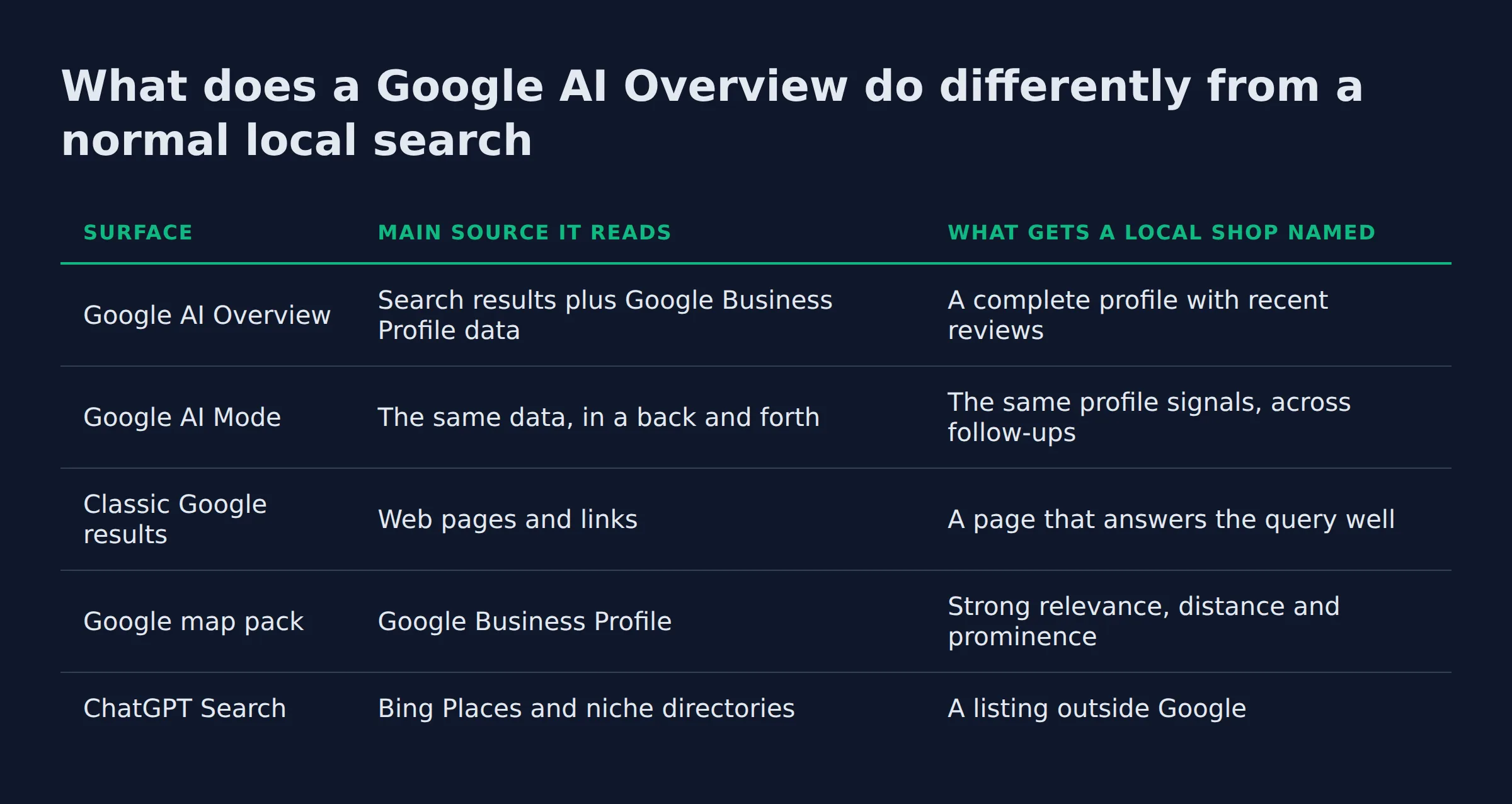
What does a Google AI Overview do differently from a normal local search?
A normal search hands you a list of links and a map pack. An AI Overview writes one answer first, then drops the links underneath. That answer can close the question by itself.
Google only shows that summary when it judges the words add something to classic Search, which its note on AI features and your website explains. The table below shows where each surface looks for a local business.
| Surface | Main source it reads | What gets a local shop named |
|---|---|---|
| Google AI Overview | Search results plus Google Business Profile data | A complete profile with recent reviews |
| Google AI Mode | The same data, in a back and forth | The same profile signals, across follow-ups |
| Classic Google results | Web pages and links | A page that answers the query well |
| Google map pack | Google Business Profile | Strong relevance, distance and prominence |
| ChatGPT Search | Bing Places and niche directories | A listing outside Google |
AI recommends only about 1 to 11 percent of eligible local businesses for a query. AI visibility also runs up to 30 times harder than a local ranking, one industry estimate of how selective AI recommendations are suggests. That figure is an estimate, and not a Google number.
A classic result is a list you pick from. An AI Overview answers for you.
The local businesses that AI Overviews name
Shops that already look complete and trusted to Google. A full profile and recent reviews do most of the work, and matching details across the web help. Thin, newer listings rarely get pulled in.
People call this Google AI Overviews SEO. It is the same local work, pointed at a new surface. Google’s own guide to how Google ranks local businesses names the relevance, distance and prominence model as its three inputs.
It also states there is no way to pay for a better local spot. Our breakdown of how local ranking works covers each input in plain terms.
From the profiles we audit, the shops that surface in the summary carry a full service list and honest photos. Most also have a review from the last few weeks. Half-built profiles stay out.
Complete finishes ahead of clever. The fresh-review profile gets named.
Does a Google AI Overview take calls away from local businesses?
An AI Overview can trim clicks to your site and still send you the right caller. When the summary names your shop, trust is built before the phone rings. When it skips you, you lose a visitor you never knew you had.
Google has begun pulling individual Google Business Profile reviews into AI Overviews, a shift that AI Overviews citing Google reviews tracked. It is a vendor observation that Google has not confirmed.
So does an AI Overview reduce clicks? Sometimes yes. On the Search Console accounts we watch, click-through rate can fall while the phone stays steady.
The questions an owner used to answer on their own site now end inside the summary.
Losing a click is fine when the summary names you. Losing the name is the real cost.
Where your Google Business Profile and location fit in AI answers
AI answers lean on where you are and what your profile says. A clear address and a wide service area do more than a stuffed keyword. Local signals carry the weight, and that is the whole of AI Overview local SEO.
Marking up your site with LocalBusiness structured data tells Google plainly what the business is and where it works. The profile fields AI answers pull from most are the ones owners fill in last:
- categories
- services
- hours
- service area
- photos
Local citations carry the same weight. The listings worth claiming first:
- Yelp
- the Better Business Bureau
- Apple Maps
Keep each listing identical to the next, down to the phone number. Review recency keeps coming up because we treat it as a live signal that needs feeding.
Your profile and your location decide most local AI mentions, more than your home page.
How do you get a local business into Google AI Overviews?
There is no button for it. You get named by doing the ordinary local work well. Fill the profile and keep your details identical everywhere. Then keep reviews coming and publish pages that answer real questions.
Google says there are no extra requirements to appear in AI Overviews, and its AI features note points back to the same basics. Its guidance on succeeding in Google’s AI experiences asks for four things:
- content that is genuinely unique
- a sound page experience
- technical access for Googlebot
- structured data that matches the visible page
Google’s older note on people-first content makes the same case under the banner of E-E-A-T. Some people now call this answer engine optimization, or AEO. It is the same local work with a newer name.
In our own keyword pull this month, “how to appear in AI Overviews” carried about 30 searches a month and low difficulty. “google ai overviews seo” ran near 110 searches with a difficulty around 50. Demand is small and the field is thin.
Here is the check we run for owners, and any owner can run it in ten minutes.
The citation test
- Search your trade plus your city. Note whether the summary names you at all.
- Check the date on your last Google review. Weeks old beats months old.
- Compare your profile, your site and your top directory listing for consistent details.
Whichever check fails is your next task. Fix it and the summary has a reason to include you.
There is no AI switch to flip. The profile work is the entry ticket.
Is Google AI Overview the same as ChatGPT and Gemini for local search?
No. Each engine reads a different pile of data, so each names a different set of shops. A business can be quoted by Gemini and skipped by ChatGPT on the same afternoon.
Gemini recommends the most and ChatGPT the fewest, and each leans on different sources, as Localogy found studying AI visibility. Gemini tracks Google Business Profile data.
ChatGPT leans on Bing Places and niche directories. Google also runs what it calls query fan-out, splitting one question into several smaller ones. Your shop has to answer the smaller questions before it can appear in the larger answer.
The work of showing up across these engines is called generative engine optimization, or GEO. Our post on getting your business into AI answers like ChatGPT covers the directory side. It is the same work we run for one-van shops every week inside our local SEO service.
Same shop, different engines, different answers. You have to show up in each source they read.
Related: How to Set Up Google Business Profile Correctly
Related: Google Business Profile Manager: What It Is and How to Use
Related: How to Track Leads From Google for a Local Business
FAQ
Is Google AI Overview a good source?
Only as good as the pages it summarizes. It draws from live results, so it inherits their accuracy and their errors. Treat it as a starting point, then check the source.
Can Google AI Overview see my location?
Usually, yes. Google pairs the summary with what it knows about where you are. The same search can show two different answers in two cities.
Is Google AI Mode better than AI Overview?
They do different jobs. An AI Overview gives one short answer on the results page. AI Mode lets the searcher keep asking. Both read the same Google data.
Is the local pack losing relevance now that AI Overviews answer local questions directly?
The map pack still drives calls and still sits on the page. What changed is that a summary now answers some questions before the searcher reaches it. Reviews and a full profile feed both.
Can an AI search help local service businesses?
Yes, once the shop is named. An AI answer can put a one-van owner in front of a searcher who never opens a link. It only helps when it names you.
If you want a straight read on where your Google visibility stands, a 15-minute call covers it. Grab a slot on our 15-minute visibility call.