Local Citations for Small Business SEO: Which Ones Count
Which local citations a small business actually needs, how to build them, and why matching NAP data beats piling on hundreds of directory listings.
Your address is already on dozens of directories you never signed up for. One of them still shows the phone number you changed 2 years ago. That is the version a customer sees first.
Most citation advice is written by people who sell citation packages. We clean up listing sets for a living, so this is the build order we actually use.
Local citations are any online mention of a business name, address and phone number. A small business needs 3 groups: the core platforms Google, Bing and Apple run, plus the data aggregators that feed every other directory. The last group is the few directories your customers check.
TL;DR
- A citation is any mention of your name, address and phone, linked or not.
- Cover the 3 core platforms first, then the data aggregators, then the directories your customers use.
- Matching NAP data across trusted sites counts more than the number of listings.
- Fix your own
LocalBusinessschema so the site agrees with the listings.
What are local citations and why do they matter for a small business?
A local citation is any online mention of your business name, address and phone number, linked or not. Google reads those mentions to judge how well known a business is.
Citations come in 2 shapes. A structured citation sits on a directory built for listings. An unstructured citation is a mention in a blog post, a news story or a chamber page. Both count, as Moz’s own local citation guide lays out.
Why they matter comes down to how a local result gets picked. Local results rest on relevance, distance and prominence. Prominence grows with how many sites link to a business and how many reviews it earns, per Google’s local ranking guidance.
That is the case for citations. They are a public record of who you are and where you work. For the full picture of what moves a local result, see our breakdown of how Google ranks local businesses.
A citation does not have to link anywhere. It has to match the name, address and phone on every other listing.
How Google actually learns about your business
Google builds a business profile from 2 places. It crawls pages on the open web, and it buys licensed data from third parties.
Your listing set starts before you claim anything. Google says profile information is compiled from licensed data from third parties alongside its own crawling, on its help page about business information. That licensed feed is the one owners never see. Fix a record inside it and the correction can travel to sites you never touched.
Your own site belongs in that set too. LocalBusiness schema gives Google the name, address and hours in machine-readable form. It is the type Google supports for a local business page (Google’s LocalBusiness schema guide).
The record Google holds can be wrong before you claim it, because a third-party feed put it there.
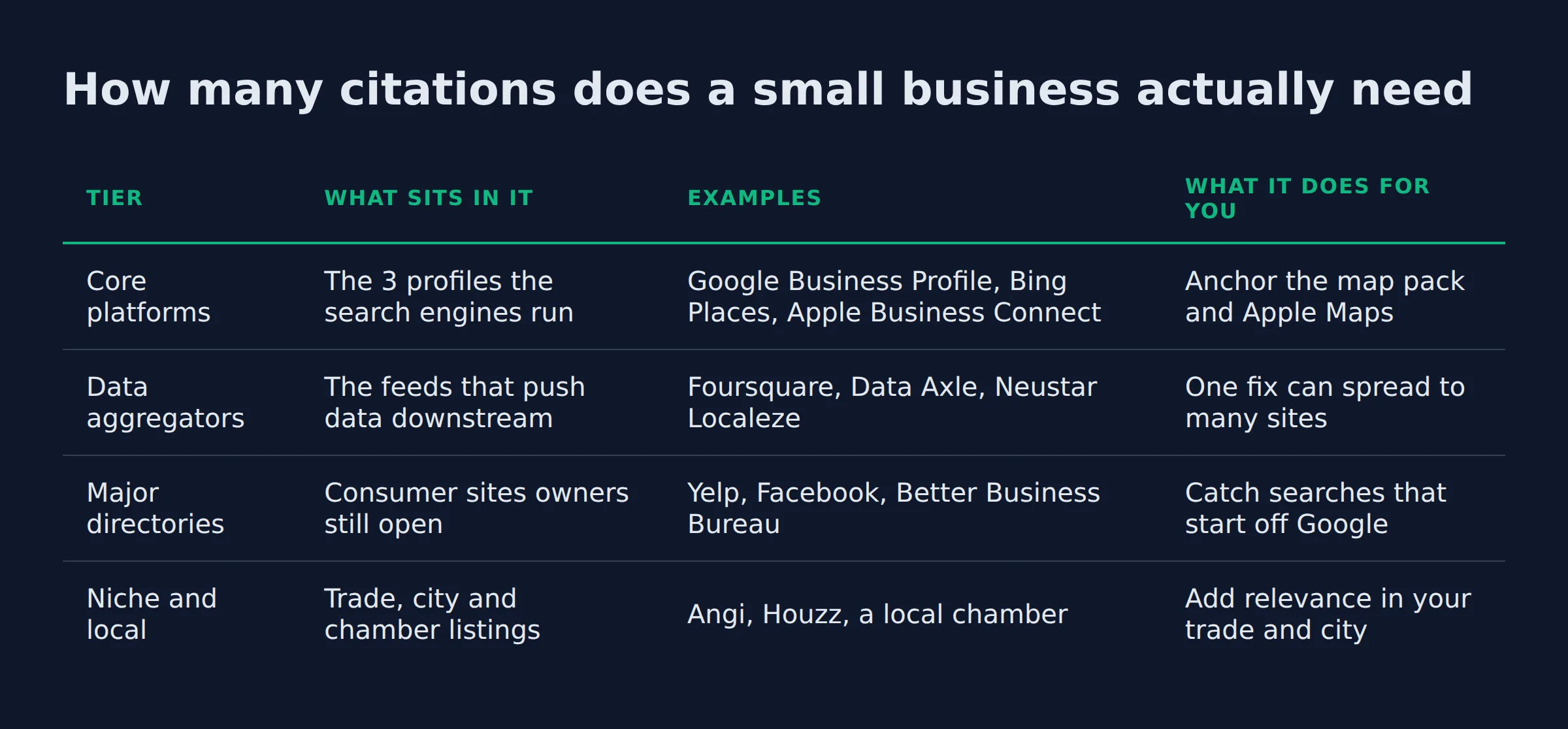
How many citations does a small business actually need?
There is no target number. Cover 3 tiers well: the core platforms, the main data aggregators, and the directories your own customers open. A hundred mismatched listings hurt more than 20 clean ones.
Owners hear “build 100 citations” and picture a checklist. The list is not the goal.
| Tier | What sits in it | Examples | What it does for you |
|---|---|---|---|
| Core platforms | The 3 profiles the search engines run | Google Business Profile, Bing Places, Apple Business Connect |
Anchor the map pack and Apple Maps |
| Data aggregators | The feeds that push data downstream | Foursquare, Data Axle, Neustar Localeze | One fix can spread to many sites |
| Major directories | Consumer sites owners still open | Yelp, Facebook, Better Business Bureau | Catch searches that start off Google |
| Niche and local | Trade, city and chamber listings | Angi, Houzz, a local chamber | Add relevance in your trade and city |
Moz sorts citations into those same tiers, from the search engines down to unstructured mentions. It names the first aggregators to submit to in its build steps.
Order matters more than count. Tier 1 has to be correct before tier 2 is worth submitting.
The mismatches we find are rarely on the core platforms. They sit on the tier 3 and tier 4 sites the owner forgot. Picture a chamber page holding an old landline, or a trade listing with a dropped suite number.
Which local citation sites should a small business start with?
Start with the 3 core platforms: Google Business Profile, Bing Places and Apple Business Connect. Claim all 3 and match the address and phone exactly. Then add Yelp, Facebook and the local chamber before you buy any package.
These profiles hold the record that most searches and phone assistants read first. Bing Places publishes a listing to a network Bing counts at 140 million daily users (Bing Places). Apple Business Connect is where the Apple Maps record is claimed (Apple Business Connect). Both are free.
| Platform | What it powers | Where you claim it | Cost |
|---|---|---|---|
| Google Business Profile | Google Search and Maps results | Google Business Profile |
Free |
| Bing Places | Bing search and Microsoft surfaces | Bing Places for Business |
Free |
| Apple Business Connect | Apple Maps place cards | Apple Business Connect |
Free |
Google asks that a business look the same across its signage, branding and listings (Google’s business representation guidelines). That rule is why the 3 profiles have to agree.
If you do only one thing, claim the 3 core profiles and keep the address and phone identical on all of them.
Yelp, Facebook and the Better Business Bureau come next, because customers still open them. A chamber or trade listing adds relevance in your city and your trade.
The 3 platforms that have to match first
Google Business Profile, Bing Places and Apple Business Connect must show the same name, address and phone before you submit to anything else.
For a business with no storefront, we claim the 3 platforms first, then hide the address and set the service area. Verification still needs a real place you can receive mail at. Publicly, you drop the pin and describe the towns you cover in words.
That is the service-area case most citation guides skip. The same representation rule is the reason a hidden address still has to be a true one.
Hide the address if you work from home or a van, but keep the name and phone identical everywhere.
How do you build local citations step by step?
Fix your own site first, claim the 3 core platforms, submit to the data aggregators, then work down the directory tiers. Use one fixed address format on every form and recheck after each batch.
Here is the order we run.
- Write the NAP once. Pick one spelling of the address and never vary it.
- Match your site to it. Put the same name, address and phone in the footer, and add
LocalBusinessschema (LocalBusiness schema markup explained). - Claim the 3 core platforms. Verify each one before you move on.
- Submit to the data aggregators. Foursquare’s Places data covers more than 100 million points of interest worldwide (Foursquare Places).
- Work the directory tiers. Claim the big consumer sites, then the trade and city ones.
- Recheck in 30 days. Data drifts back when a source feed still holds the old version.
A manual submission takes a few minutes when the NAP is already written down. It takes several times that when we have to hunt for a login. That is why we fix the core 3 before anything else.
Write the address one time, then paste that same string into every form you fill.
Why does NAP consistency matter more than citation count?
NAP is name, address and phone. Consistency means the same 3 fields in the same format on every site. When a dozen versions disagree, none of them reads as verified. A clean set on trusted sites does more work than a long set of mixed ones.
The address has one standard. USPS Publication 28 is the official US format for postal addresses (USPS address format). Most mismatches are small. They are a St. against Street, a missing suite number, or a phone number with and without the country code.
One wrong character in a suite number can split one business into 2 records.
The most common mismatch we find is a phone number that changed years ago and a directory that never caught up. The phone still rings, so the owner never chases it.
What a clean listing looks like next to a neglected one
A clean listing agrees on 5 fields everywhere: name, address, phone, hours and category. A neglected one disagrees on at least 2 of them and often carries a hidden duplicate.
| Field | Clean listing | Neglected listing |
|---|---|---|
| Name | Same name on every site | Old name on 2 directories, new name on Google |
| Address | One USPS-format address | Suite dropped, St. and Street mixed |
| Phone | One live tracked number | Old landline still posted somewhere |
| Hours | Set and updated for holidays | Missing, or hours that closed a year ago |
| Duplicates | None | A second record from an old suite |
Search your business name plus the city the way a customer would, and read what the first 3 results actually show.
Are free citation sites worth it, and when do you pay for a citation building service?
Free listings are worth it when the site is real and stays live. Pay a citation building service for the data aggregator tier and for duplicate cleanup you will not do yourself. Most bulk packages add unindexed pages instead of visibility.
| Route | What you pay | What you get | When it is worth it |
|---|---|---|---|
| Claim the core 3 yourself | Nothing | The records most searches read | Always, first |
| Free directory listings | Nothing | Mentions on sites that load | When the site is live and indexed |
| A citation building service | A fee, monthly or one-time | Submissions, cleanup, duplicates removed | When you want the feeds handled |
| A bulk 100-site package | A flat fee | Mostly dead or unindexed URLs | Rarely |
The paid drop we stopped buying was a bulk package of tiny directories. Months later most of the links were dead, and a few had copied the same wrong phone number onto fresh pages. A citation building service earns its fee when it removes duplicates and keeps the core 3 matched, and when it stops before the tiny sites.
If you would rather not manage the feeds yourself, our local SEO service runs this whole stack for you.
Pay for cleanup and the aggregator tier. Skip any package that sells hundreds of directories as the point.
How do you check whether your citations are helping or hurting?
Search the business name plus the city, then search the phone number on its own, and read the first 2 pages of each. A wrong record in either result means a source feed still holds the old data.
A local citation checker speeds this up. Moz Local and BrightLocal both scan the big directories and flag mismatches. BrightLocal also tracks how the same record shows in ChatGPT and Google’s AI answers (BrightLocal). AI answers pull from the same public records, so a stale listing can follow you into them.
Search the phone number by itself. A number search finds old and duplicate records that a name search misses.
Getting a straight read on your citations
If you want a straight read on where your citations are leaking, a 15-minute call covers it. We open your listing set, find the mismatches, and name the first 3 fixes. The read is yours to keep.
You can book that call here: https://link.localbizboost.com/widget/booking/lobOMW2RpbL2Vu9SblWG
Related: are my business citations helping or hurting
Related: how to get backlinks for a local service business
Related: Why Am I Not Showing Up on Google Maps?
FAQ
What are some good local citation sites?
Google Business Profile, Bing Places and Apple Business Connect come first. Add Yelp, Facebook and the Better Business Bureau. Then add a chamber or trade listing for your city and your trade.
What citations do you use for a business?
Any site that shows your name, address and phone counts. Claim the search engines first. Then claim the data feeds behind them, and the consumer directories your customers open.
Is doing local SEO worth it?
Local SEO is worth it when customers search for a service plus a city. The map pack shows there, and matched listings help a small business compete for it.
How many citations does a small business need?
No fixed number fits every business. Cover the 3 core platforms, the main data aggregators and the biggest directories in your trade, then stop. Clean beats long every time.
Do free citation sites work, or do you need to pay?
Free sites work when the listing loads and stays live. Pay for the aggregator tier and for duplicate cleanup, which is where a citation building service earns its fee.