Are Your Business Citations Helping or Hurting?
How to tell if your local citations are helping or hurting rankings, what an inconsistent NAP does to your Google profile, and how to fix bad listings.
Search your business phone number by itself, with no name and no city. Most owners never do this. When we run it on a new audit, the results always include a record the owner did not create.
Your address already sits on dozens of directories nobody asked you to join. One still lists the suite you gave up when you moved. That is the version some customers see first.
Citations help when your name, address and phone match everywhere. They hurt when old versions of that data survive on live sites. The damage comes from inconsistent NAP details, duplicate listings and dead directory pages. Adding more listings does not fix any of that. Search your phone number by itself: that is the fastest way to surface records working against you.
Most citation advice comes from people who sell citation packages. We clean up listing sets for a living, so this is the read we would give an owner across the desk.
TL;DR
- A citation is any online mention of your name, address and phone, linked or not.
- Matching NAP data across trusted sites beats the number of listings you own.
- An old phone number or a dropped suite splits your business into 2 records.
- Search your phone number alone to find the listings working against you.
What counts as a citation for a small business?
A citation is any online mention of your business name, address and phone number, whether or not it links to your site.
Citations come in 2 shapes. A structured citation sits on a directory built for listings, like Yelp or a Facebook Page listing. An unstructured citation is a mention inside a blog post, a news story or a chamber page. Moz splits them the same way in its guide to where to get business citations.
The list of places that count is longer than most owners expect. Local citations are the public record of where you are and how to reach you. Google Business Profile, Bing Places for Business and Apple Business Connect hold the copy each search engine trusts most. Yelp, a Facebook Page listing and the Better Business Bureau cover the sites customers still open by hand.
The platforms are the easy part. What owners miss is the second layer, where an aggregator feeds the same record to dozens of sites at once. For the build side of that, see which local citations a small business actually needs.
What makes a citation work is that your name, address and phone match everywhere it appears.
Do citations still help a local business rank in 2026?
Citations still help. Search engines read matched listing data to confirm how well known a business is, and that prominence feeds local results today.
The practice changed over the years. The old playbook for local seo citations pushed volume and treated a longer list as a win. Practitioners now rate accuracy above quantity, and they rate merging or deleting duplicate citations highly, according to BrightLocal’s expert citation survey.
Google names 3 local ranking factors: relevance, distance and prominence. Prominence grows with how many sites mention your business and how many reviews you collect, which is where citations do their work. That comes straight from its guidance on how local results pick a business.
Then there is AI search. Whitespark’s study on local search ranking factors found 3 of the top 5 factors for showing up in AI answers are citation factors. ChatGPT local answers and Google AI Overviews read the same public records, so a stale listing can follow you into them.
What we see on the accounts we touch: an accurate Google Business Profile, Bing Places and Apple Business Connect drive map-pack movement. The deep directory tiers rarely move a position on their own. To see what else moves a local result, read how Google ranks local businesses.
A matched listing set helps you get found in the map pack and in the AI answers that read the same records.
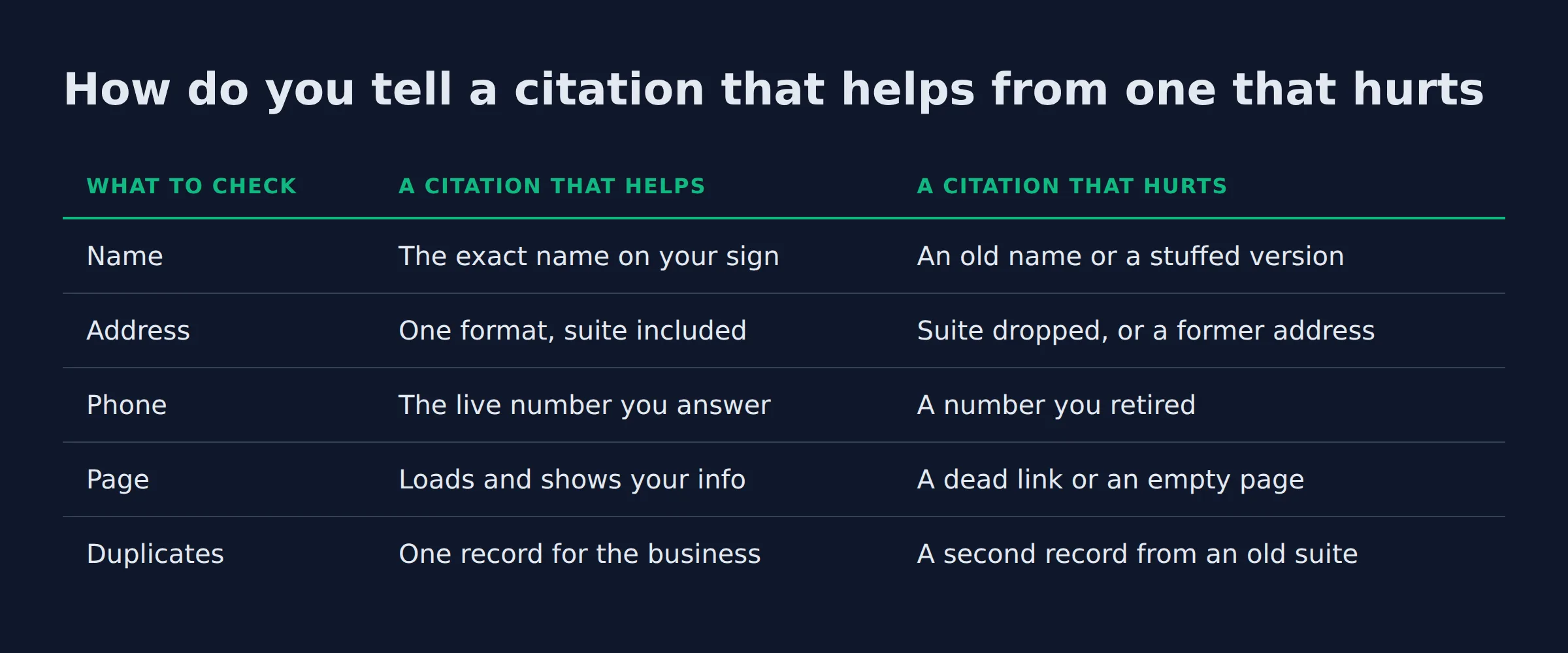
How do you tell a citation that helps from one that hurts?
A helpful citation matches your current name, address and phone. A harmful one shows old data, points to a dead page, or creates a duplicate record of your business.
A local citation audit comes down to 2 tests. Does the listing agree with your current NAP? Does the page still load?
| What to check | A citation that helps | A citation that hurts |
|---|---|---|
| Name | The exact name on your sign | An old name or a stuffed version |
| Address | One format, suite included | Suite dropped, or a former address |
| Phone | The live number you answer | A number you retired |
| Page | Loads and shows your info | A dead link or an empty page |
| Duplicates | One record for the business | A second record from an old suite |
Most of the harm sits on listings that are live and wrong. A missing listing just sits there. A wrong one gets read, and the reader believes it.
That is why the first pass is worth the hour. On a first audit, the defect we find most is a phone number the owner changed years ago that still sits on 5 or 6 live directories. The retired number routes nowhere, so the owner never sees the problem.
BrightLocal’s consumer research found customers lean on reviews and local listings before they call. A wrong record gets read at the exact moment the customer decides.
One live directory page showing your old number does more damage than ten sites that never listed you.
What does an inconsistent NAP actually do to your rankings?
An inconsistent NAP splits your business into competing records. When Google cannot confirm which one is real, it trusts your profile less.
NAP means name, address and phone. NAP consistency means those 3 fields read the same on every site that lists you. When 2 versions of the same field go live, the engine has to pick one.
A wrong record carries real risk beyond a missed click. Google’s rules require an accurate name and address, and they allow a suspension for misrepresentation, which is what Google’s business representation guidelines state outright.
| Field | What a mismatch does | What it costs you |
|---|---|---|
| Phone | Splits calls across 2 numbers | Missed calls from one record |
| Address | Creates a second pin or drops you off the map | Map clicks you never see |
| Name | Splits the business into 2 identities | Reviews spread thin across both |
A wrong phone number takes calls the moment someone taps it. A wrong address costs map clicks. In what we see, the phone error is the one that quietly bleeds calls for months, because nothing in the owner’s day surfaces it.
A split record lowers Google’s confidence in your listing, and confidence decides whether you show up at all.
How do you check your own citations for problems?
Search your business name and city, then search your phone number alone. Read the first 2 pages of each, and list every record that disagrees.
The order matters. Run the name search first to see how a customer sees you. Then run the phone number on its own, with no name attached, to pull up records you did not know existed.
| Check | How to run it | What a problem looks like |
|---|---|---|
| Name search | Your business name plus the city | An old name or a closed listing |
| Phone search | The number alone, no name | A record you never created |
| Address search | Your street address in quotes | A second pin or a former suite |
| Page load | Click into every result | A dead link or an empty page |
Checking a few dozen listings by hand works when your set is small. Past that, a local citation checker does the sweep for you. Moz Local, BrightLocal and Whitespark each scan the major directories and list every version of your record in one place. BrightLocal’s primer on how citations work in local SEO explains what those records feed downstream.
Build the full list before you change a single record, so the duplicates show themselves in the audit.
How do you fix or remove a citation that is hurting you?
Correct the record where it lives first. Fix the source feed or the directory listing itself, because a downstream edit gets overwritten when the feed pushes again.
A wrong record can live in 3 places: on the directory page you can see, in the data feed that published it, or on your own site. Where it lives decides how you fix it.
| Where the wrong record lives | What to do | Why it works |
|---|---|---|
| On a directory page only | Claim the listing and correct it | The page is the source of the error |
| In a data feed | Fix it at the feed (Foursquare, Data Axle, Localeze, Acxiom) | One fix travels to many sites |
| On your own site | Update the footer and LocalBusiness schema |
Stops your site feeding the old data |
| As a duplicate | Claim it and request a merge or a suppression | One record beats 2 |
Data aggregators like Foursquare, Data Axle, Localeze and Acxiom sit behind a wide swath of directories. Correct one there and the fix can spread to sites you never touched. Moz puts those aggregators at the start of its build list for that reason, in where to get business citations.
Every listing should match one master record: your Google Business Profile. Get that right first with our guide to setting up a Google Business Profile correctly.
Duplicates need their own step. When a second record is too tangled to merge, you can ask the platform to suppress it so it stops competing with the real listing. Removing a record you cannot fix beats leaving 2 versions live.
When a wrong record lives on both a feed and a directory page, we fix the feed. A downstream edit gets pushed over the next time the feed runs.
We bought one of the bulk 100-site packages early on. Months later, most of those URLs were dead, and a few had copied the same wrong phone number onto fresh pages.
A citation building service earns its fee when it removes duplicates and keeps the core platforms matched, and when it stops before the tiny sites. A sync tool like Yext does the same job if you would rather automate it.
If you would rather not manage the feeds at all, our local SEO service runs this whole stack for you.
A duplicate listing you merge does more for you than a new listing you add.
Related: Why Am I Not Showing Up on Google Maps?
Related: Google Business Profile Manager: What It Is and How to Use
Related: Map Pack vs Organic Results: Local SEO Explained
FAQ
Is a citation a good or bad thing?
A citation is neutral on its own. It helps when it matches your current name, address and phone, and it hurts when it carries old data or a dead link.
Is 100 citations a lot?
Count is the wrong measure. 20 clean, matched citations on trusted sites do more for you than 100 mixed ones. Accuracy is what practitioners rank first.
Can a bad citation get my Google Business Profile suspended?
Yes, in the worst case. Google’s rules require an accurate name and address and allow a suspension for misrepresentation, so a wrong record is more than a missed click.
Are free citation sites worth it, or do you need to pay?
Free listings are worth it when the page stays live and indexed. Pay a citation building service for the data aggregator tier and for duplicate cleanup you will not do yourself.
How often should I check my citations?
Check the core platforms every 30 days, and the wider set every 3 months. Data drifts back when a source feed still holds the old version.
Getting a straight read on your citations
If you want a straight read on where your Google visibility stands, a 15-minute call covers it. We open your listing set, find the records working against you, and name the first 3 fixes. The read is yours to keep.
You can book it here: https://link.localbizboost.com/widget/booking/lobOMW2RpbL2Vu9SblWG