Map Pack vs Organic Results: Local SEO Explained
The map pack and organic results rank by different rules. Here is how Google decides each, what moves the pack, and what to optimize first.
Every local search opens with a map and 3 names on it. Your competitors hold 2 of the slots. The third went to a business you have never heard of.
Here is the plain difference. The pack and the organic links obey different rules.
The map pack is Google’s block of three local businesses shown with a map. Organic results are the ranked links below it. The pack ranks on relevance, distance, and prominence.
Organic results rank on content, links, and site quality. Win the pack with a complete Business Profile and steady reviews. Win organic with a website that answers searches.
TL;DR
Two races run on one page. The map pack ranks businesses on relevance, distance, and prominence. Studies put the Business Profile at up to 32% of it. Organic results rank pages on content, links, and quality.
For a local service business, the pack sends the calls. The website earns the click. Chase the pack first, then support it with the site.
Most pack-versus-organic advice is theory written away from real profiles. This is the operator version. Every uncited line is something we see in real audits.
What is the local pack, and how does a business get into it?
The local pack is the block of 3 businesses with a map at the top of local Google results. Google fills it from relevance, distance, and prominence. A complete, verified Business Profile with steady reviews is the fastest way in.
The pack appears whenever the search carries local intent, per BrightLocal’s guide to the local pack. It shows the 3 most relevant results. Only 3 fit.
The format is recent. Google moved from 7 plain links to 3 with a map in 2015, built for phone screens, per the same guide.
The fastest single move is verification. It is where every audit we run starts, because an unverified profile cannot do the ranking work at all.
The businesses that hold the 3 slots share two things in practice: a verified profile and a recent stream of reviews. The same profile feeds Google Maps, so the pack work is the Maps work. The profile is the same on both.
The pack has 3 slots, and a verified profile decides who competes for them.
How are map pack rankings different from organic rankings?
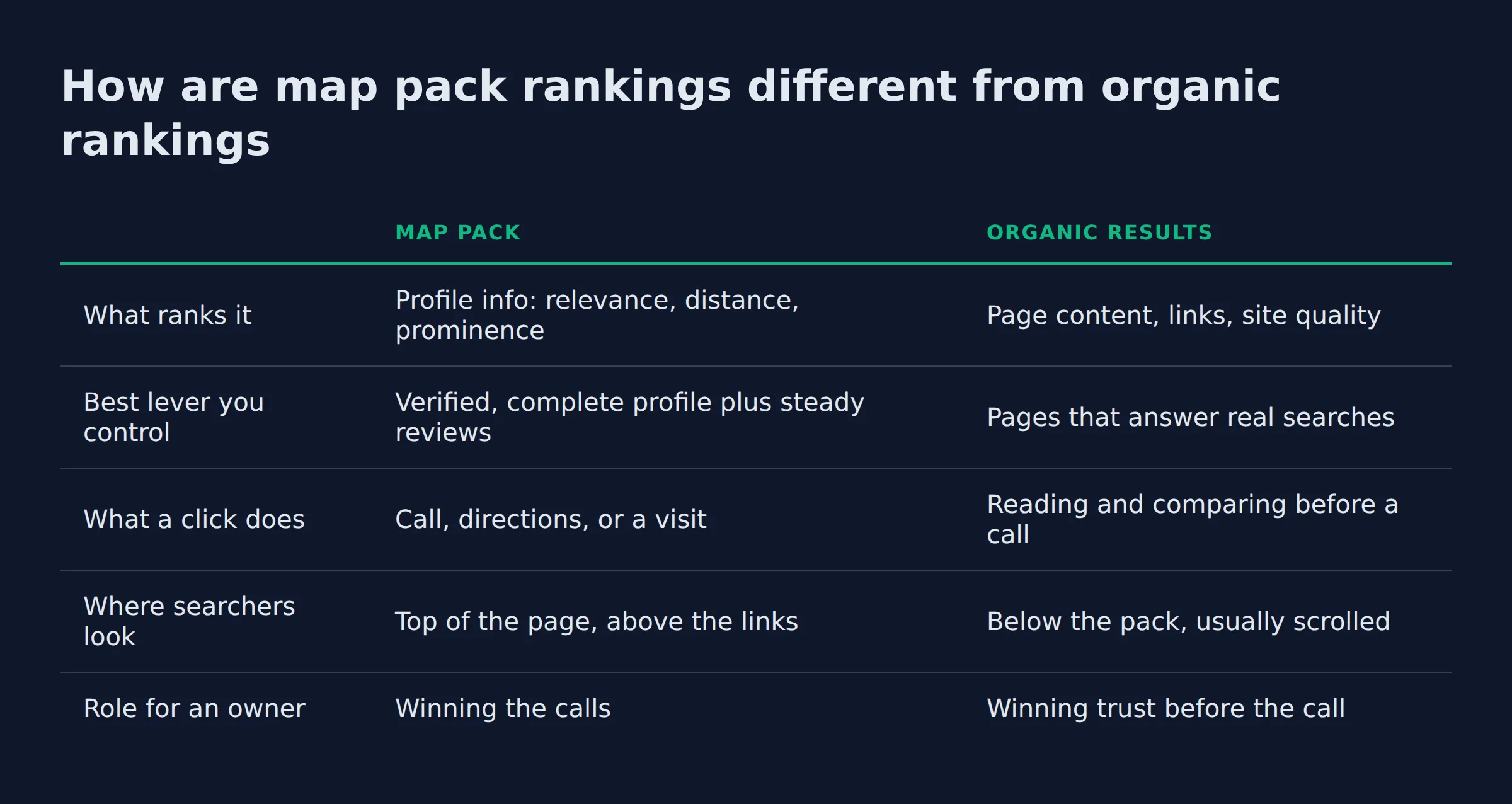
The pack ranks businesses on profile strength, proximity, and reputation. Organic results rank pages on content, links, and site quality. The pack answers “who is close and trusted,” and organic answers “which page explains this best.”
| Map pack | Organic results | |
|---|---|---|
| What ranks it | Profile info: relevance, distance, prominence | Page content, links, site quality |
| Best lever you control | Verified, complete profile plus steady reviews | Pages that answer real searches |
| What a click does | Call, directions, or a visit | Reading and comparing before a call |
| Where searchers look | Top of the page, above the links | Below the pack, usually scrolled |
| Role for an owner | Winning the calls | Winning trust before the call |
The split follows search intent. “Roof repair near me” triggers the pack, and “how much does roof repair cost” triggers the blue links. BrightLocal’s guide says the pack appears for local-intent queries, and that is the whole pattern.
Behavioral signals differ too. Ranking studies count click-through rate and clicks-to-call as engagement signals, per Merchynt’s ranking guide. What we see in accounts matches that.
A pack click usually means a call. An organic click usually means reading.
Whatever the device, the pack sits first. Phones and voice assistants read the same result page. Desktops do too.
The pack ranks the business. Organic ranks the page. They reward different work.
One business, two results: what the audits show
Most of the profiles we audit win one result and near-ignore the other. We see it every week. The pattern is consistent enough to plan around.
Take a roofer with a complete profile and a steady review flow. It holds a pack slot, and its website is one thin page that barely shows in organic. Still, it gets calls. The click goes straight to the phone.
The reverse is just as common. An HVAC shop writes real pages for every service and ranks in organic, but its profile is half-empty and light on reviews. People read the pages, then call the pack businesses instead.
Owners tell us they are “on the first page.” They are. Their site sits in the blue links under the map, and the 3 businesses above it get the attention. Ranking on page 1 and winning the pack are different wins, and the phone only rings for one of them.
Chase the pack first. It is the result that sends calls, and the profile work moves it fastest. We do the profile before the site on every account.
One-sided wins are the norm in audits: the pack or the site, rarely both, and the calls follow the side that is funded.
What are the top 3 ranking factors in Google?
Google ranks local results on 3 factors: relevance, distance, and prominence. You control 2 of them, and distance is the one no profile edit changes. A complete profile, steady reviews, and consistent listings feed the factors you can move.
Google’s own description of how Google’s local ranking signals work says local results are mainly based on relevance, distance, and popularity. There is no pay lane. Google says so plainly.
Google stops at the 3 names. The weights come from ranking factor surveys, and they keep moving.
| Factor | What it covers | Weight the studies found |
|---|---|---|
| Google Business Profile | Categories, hours, service area, verification | Up to 32% of local pack factors |
| Reviews | Quantity, velocity, sentiment | About 20%, up from 16% in 2023 |
| NAP consistency | Same name, address, phone everywhere | 40% more likely to make the pack |
| Website content | Pages that match a search | 24% of AI-search visibility factors |
Distance is the factor you cannot touch. Your location either serves the search or it does not. That moves all the work to relevance and prominence, which are profile work. We tell owners that early.
The full model, weights and all, lives in our guide to how Google ranks local businesses.
Distance never changes with profile work, so relevance and prominence carry the whole effort.
How much does the Google Business Profile matter versus the website?
For local searches, the profile outweighs the website. Surveys put the profile at up to 32% of pack ranking factors and on-page content at 24% of AI-search visibility. The profile does the ranking, and the website does the converting.
The 32% figure comes from ranking factor surveys, the same research that measures on-page signals at 24% of AI-search visibility. AI Overviews changed the read. The same guide says Google now weighs how your info appears in AI-generated summaries.
We audit profiles where the website is polished and the category is still wrong. The money went to the side Google weighs second. That order is the fix.
The profile comes first. It is where our local SEO service starts working.
A polished website cannot outwork a half-empty profile in the pack.
What is Google’s 20% rule?
There is no official 20% rule. Google’s help pages never mention one, and Google’s ranking model names just 3 factors. The number comes from ranking factor studies, which put reviews at about 20% of local factors, up from 16% in 2023.
Ask about the rule and you get different versions. Some say reviews are a fifth of local ranking. The versions disagree.
Others say spend a fifth of your week on the profile. Google never wrote that. Its ranking help page names factors, not percentages.
We checked. The page has no 20% anywhere.
The number is real, just not a rule. Review signals weigh about 20% of local ranking according to the surveys, and the weight grows year over year. That is worth acting on.
The free work stays the same either way.
- Verify the profile and finish the fields.
- Keep reviews coming.
- Keep your business info consistent.
Google is plain about it, per its help page: no one can pay for a better local ranking.
There is no 20% rule on Google’s books. Reviews weigh about 20%, and the studies update every year.
Related: why am i not showing up on google maps
Related: how to set up google business profile correctly
Related: google business profile categories for service businesses
FAQ
How do I check where my business ranks in the map pack?
Check from the area you serve, in a private window, on a phone. Write down the 3 names in the pack, then find your own site below them. Repeat monthly, and the trend appears.
Google Search Console is the free way to watch your site’s presence in search results, per Google’s Search Console help. Rank trackers record pack positions for you, and the manual check costs nothing.
How do I get my business on top of Google search for free?
The free levers are few. Verify the profile, then finish every field. Fix the listings where your contact details disagree, then keep a steady review flow going.
Google says there is no way to request or pay for a better local ranking, per its help page. The free work is the real work.
Do citations and NAP consistency still matter in 2026?
Yes, and the effect is measurable. Businesses with consistent contact data across directories are 40% more likely to appear in the local pack, per ranking factor research. Citations are mentions of your business on other sites, and consistency across them builds the trust the pack reads.
How big a factor are reviews for local ranking?
Reviews sit second to the profile. Studies put review signals at about 20% of local ranking factors, up from 16% in 2023, per the surveys. Count and rhythm matter, and profiles that earn a few new reviews every week hold the pack longer than profiles that jumped once. We see it in every audit.
The straight read
The pack and the organic results are two races on one page. Most owners fund one side. Each race rewards different work.
If you want to know which result does your selling, a fifteen-minute call covers it. We open your profile and your site together. Then the gaps show.