Do You Need a Website for a Google Business Profile?
Google does not require a website for a Business Profile. See what you lose without one, when a profile is enough, and what to put in the website field.
A customer finds your business on the map and taps it. They read the hours. Then they look for the website. If that field is empty, they tap the next name on the list.
Most of what gets written about this question comes from people who have never opened the fields they describe. This is the plain version.
No. Google’s eligibility rules for a Business Profile never mention a website, and you can create, verify and manage a profile without one. Calls and direction requests still come from the map pack. But Google builds prominence from links to your business and your reviews, so a missing site costs you visibility.
TL;DR
- A Business Profile does not need a website to be created, verified or shown in the map pack.
- A missing site costs you prominence and the click. It does not block eligibility.
- The website field accepts one site, and it has to be the business’s own.
- The free page Google used to host for owners is gone, and nothing stands in for a real site.
Do you need a website to create or verify a Google Business Profile?
No. The eligibility rules turn on in-person contact with customers during your stated hours. A website is not on that list. You can create and verify a profile with no site at all.
Owners ask us a version of this question every week, usually as “do I need a website for my Google Business Profile”. The site is not the first hurdle.
Google’s eligibility and ownership guidelines cover the in-person contact rule, and they never mention a website. Google’s verification help page lists 4 routes instead, and every one of them runs on your phone or your address:
- A postcard by mail
- A phone call or a text message
- An email address you control
- A live video call, where a rep watches you show the premises
Timing is the only real wait. Most postcard codes arrive within 14 days, and Google reviews the verification within 5 business days, per Google’s verification page.
You also do not have to be the person typing in the fields. Only the owner or an authorized representative can verify and manage the listing, and the address still has to be a real one.
The eligibility rules bite in exactly one case. A business with no in-person contact at all cannot get a profile, and Google’s guidelines list online-only businesses as ineligible.
Everything that decides your search coverage sits inside the profile:
- The main category, which sets the searches you can match
- Services, which name the jobs you take
- Attributes, which answer practical questions about how you work
- Opening hours, which tell Google when to show you
- Your name, address and phone number, which have to match your directory listings
Eligibility turns on the physical business, not the website field.
Can you rank on Google without a website?
Yes. A profile with no website can rank in the map pack. Local results turn on relevance, distance and prominence, and a complete, verified profile feeds relevance directly. A site helps with the links that build prominence.
The profile carries real weight on its own. In the profiles we audit, a complete listing with an empty website field still collects calls and direction requests every month. Owners can watch that in the performance report, which counts calls and directions separately from website clicks.
The demand behind those taps is steady. Local search behavior data shows 84 percent of consumers searched for a local business in the past 3 months. On top of that, 72 percent use Google to find local business information.
What a profile cannot hold is the proof. There is nowhere to put before-and-after photos of a finished job. There is no price list either, and no page that answers the question a customer asks before they book. The profile gives you one description box and a fixed set of buttons.
That gap sends owners to Google Ads. Local Services Ads and Performance Max both sell placement near a search, and neither one fills the profile’s fields.
A profile alone can win the call. It cannot carry the proof.
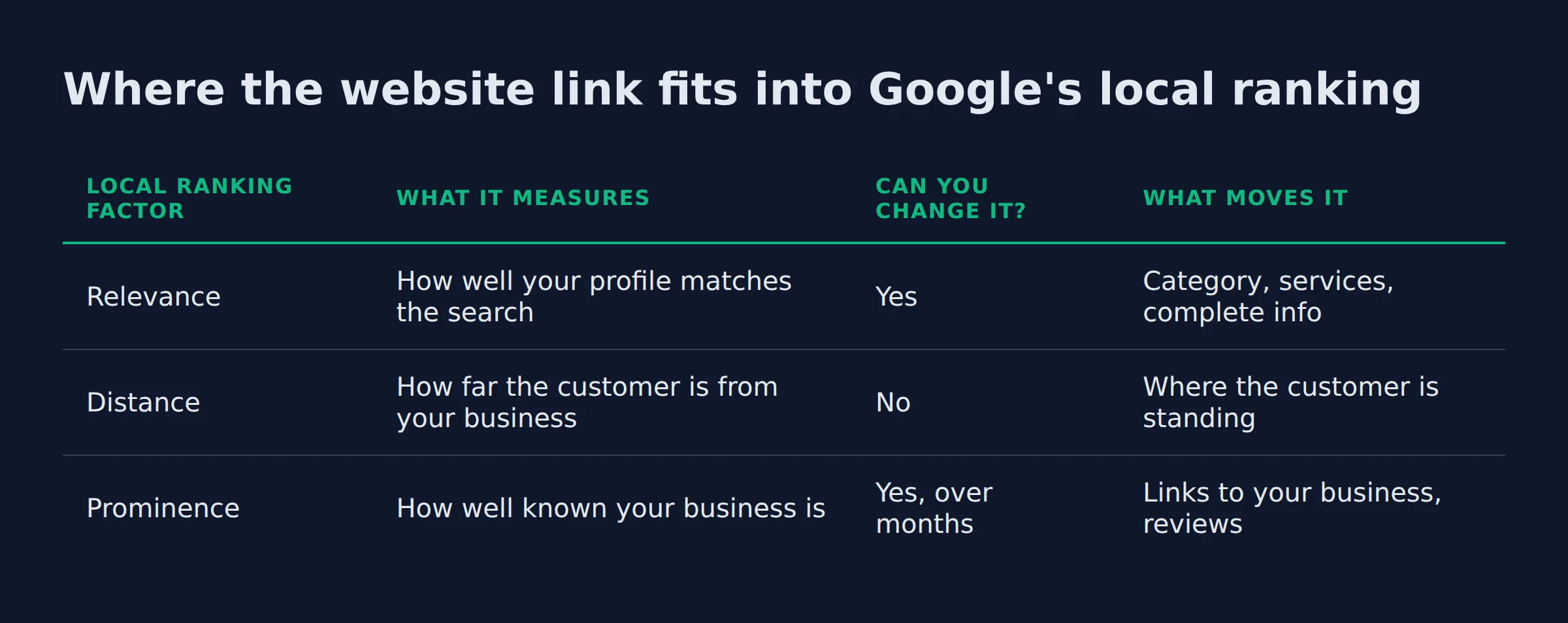
Where the website link fits into Google’s local ranking
Prominence is where a website link does its work. It grows from links to your business and from your reviews, and a site is what those links point at.
Google’s own guide to relevance, distance and prominence names the 3 factors behind every local result. A Google Business Profile ranking comes from those 3 working together.
Where the website link fits into Google’s local ranking
| Local ranking factor | What it measures | Can you change it? | What moves it |
|---|---|---|---|
| Relevance | How well your profile matches the search | Yes | Category, services, complete info |
| Distance | How far the customer is from your business | No | Where the customer is standing |
| Prominence | How well known your business is | Yes, over months | Links to your business, reviews |
The table above is also the order of the work. Fix relevance first, then give prominence something to build on.
Reviews do a second job on top of ranking. Consumer review survey data shows 54 percent of consumers visit a business’s website after reading positive reviews. When the field is empty, that visit has nowhere to land.
Managing the profile matters even before someone clicks. Consumer survey data says 96 percent of consumers think it is important that a local business manages its online presence. And 33 percent call it essential.
Google’s AI answers now sit above both. Our read on whether Google AI Overview helps local businesses covers what they do with your profile and your site.
The 3 factors stack in a clear order, which we walk through in how Google ranks local businesses.
Distance is the one factor you cannot touch.
What is Google allowed to see in that website field?
One site, and it has to be the business’s own. The website on a profile has to be the single authoritative site for that business. The content on it has to be managed by the owner.
Google’s ownership guidelines are blunt about it. They call for the single authoritative website for the business, verifiable by the owner.
That rules out most of the shortcuts. The guidelines for representing your business do not allow URLs that send users to landing pages other than your own. That covers pages created on social media sites.
In the profiles we audit for owners who say they have no website, one of three things usually sits in the website field. A Facebook page, a booking platform page, or a directory listing.
Two of those three break the rule above. A booking platform page sends the customer to another company’s page. A social page does the same thing, which is why a Facebook link is not a substitute for a site.
An empty field is legal, and it beats a link that breaks the rules. A missing website will not cost you the profile. A bad URL can.
Some owners still have an old free page from Google in that field. Business Profile websites were shut down on March 1, 2024, and the redirect to the profile ended on June 10, 2024. Every visit after that hit a dead page.
The owners who built one usually hear about it from a customer. They ask us what replaced it. Nothing did.
The field test we run before we touch a profile
Any URL has to pass 3 checks before it goes in the field:
- Does the owner control the domain and the content on the page?
- Does the link open the page for this location, rather than a template or an aggregator?
- Could a customer read that page and call this business without being pushed somewhere else?
One no keeps the URL out. We would rather see an empty field and a working phone number than a link that breaks the rules.
An empty field is legal, and a social page in the field is not.
Should a service-area business use a website or a profile link?
A service-area business can run on the profile alone, and plenty do. Google’s guide to service businesses lists the same profile fields for them as for anyone else. Customers never have to visit an address.
Google splits service businesses into 2 types. A service-area business profile is one that visits or delivers to customers directly and does not serve customers at its business address. A hybrid business does both, like an auto shop that also runs roadside calls.
Getting your business on Google Maps follows the same path for both types. The listing and the map pin come from the profile, and the areas you serve can cover several towns from one pin.
The address stays hidden. Google’s guidance is to clear your business address from the profile when customers never come to you.
The weak spot is the tap after the tap. A customer on a service-area profile with no site lands on a map pin, a few photos and a phone number. If they want a quote, there is no form to fill and no service page to read. The next tap goes to a business that has one.
The fix is smaller than most owners expect. One page on a domain you own can carry a service list, a few photos of finished work and a short request form. That page does not have to be pretty to do the job.
Without a storefront, the profile wins the search and a single page wins the quote.
What to do first when you have no website yet
Claim and complete the profile first, and leave the website field empty until you own a page worth sending people to. An empty field is allowed. A rented page on someone else’s platform is not.
Work in this order:
- Claim or create the profile, then finish verification.
- Fill every field, including services, attributes and the areas you serve.
- Keep your name, address and phone number identical everywhere, from the profile to your directory listings.
- Start the review ask on every job, and reply to each review you get.
- Add photos, and post an update every week or two.
- Build one page on a domain you own, then add LocalBusiness structured data so Google can read the details on it.
- Connect Search Console and check the profile’s performance report once a month.
Most owners clear the first 4 steps in an afternoon and stall at the site. That part we build as part of our local SEO service.
Move in this order for a reason. A new website attached to a half-finished profile still loses to a competitor with a full profile and no site.
Fill the profile first, then build the smallest site that can hold your proof.
Related: How to Set Up Google Business Profile Correctly
Related: Local Service Website Pages That Rank on Google
Related: Map Pack vs Organic Results: Local SEO Explained
Related: google business profile manager
FAQ
Can you have a Google Business Profile without a website?
Yes. Google’s eligibility rules never mention a website, and a profile can be created, verified and managed with that field left empty.
What happens to your local ranking if the website link is missing from the profile?
Nothing is blocked. You lose the links a site would earn, and those links feed prominence. Prominence decides how often you show beyond a tight radius.
Can you get calls and direction requests without a website?
Yes. Google’s performance report lists calls and direction requests as separate actions from website clicks. The first 2 need no site at all.
What does the profile’s website field accept, a homepage, a landing page, or a booking link?
The business’s own site, with the page for that location as the best choice. A booking platform page or a social page breaks Google’s rules, because it sends the customer somewhere other than the business.
Is a website or a Google Business Profile more important for local SEO?
The profile is the lead asset inside the map pack. A website wins the click that follows and earns the links that feed prominence. A profile with no site can still bring in calls.
How long does it take a new profile or a new site to show up locally?
Verification is the first wait. Most postcard codes arrive within 14 days, and Google reviews verification within 5 business days. A new site then gets crawled and indexed over the weeks after that.
Where to start this week
Fix the profile side first. The site can wait a month, and one page is enough when it arrives.
At Local Biz Boost we keep the profile, the reviews and the site pointed at the same business details. Each one supports the others.
If you want a straight read on where your Google visibility stands, a 15-minute call covers it.