Do Google Business Profile Posts Help Ranking? Get the Data
Google Business Profile posts are not a local ranking factor. What Google's docs and the Sterling Sky test show, and what posts do earn.
Your posts get views. The phone stays quiet. Someone sold you a monthly posting package and said the ranking would follow.
Google Business Profile posts do not move local pack rankings. Google’s local ranking guide names relevance, distance, and prominence, and no post signal is on that list. A nine-week Sterling Sky test on 3 listings found no measurable change. Posts still earn clicks, so treat them as a customer channel.
TL;DR
Posts do not move local pack rankings. Google’s ranking guide names relevance, distance, and prominence, with no post signal on the list.
Sterling Sky tracked 441 keywords per location through 9 weeks of weekly posting and saw no measurable change in the map pack.
Posts still earn clicks and calls. Keep posting for customers, and spend your ranking hours on your category, your reviews, and your profile fields.
Advice on this question mostly comes from people who have never managed a profile. Every number below comes from a source you can open, and the pattern notes come from profiles we audit.
What do Google Business Profile posts actually do?
A post is a short update with text, a photo, or a link. It shows on your profile in Search and Maps and holds no ranking position. Google describes posts as a way to share announcements and offers with customers.
The same page says your latest updates help customers decide to visit. It also says where customers find them. On a phone, posts sit in the “Updates” or “Overview” tab, per Google’s post help page. On a desktop, they sit in the “From the owner” section.
Google gives you 3 post types, and each one asks for different details:
- Updates: a description, a photo or video, and an action button with a link.
- Offers: a title, dates, and times, plus an optional coupon code and terms.
- Events: a title, start and end dates, and times.
When we audit a profile, the posts with the most views are usually the ones with nothing for a customer to click. A view is the easy part of this work. A call needs a reason attached.
A post is a message inside your profile, and it does not take a ranking slot.
What actually moves local rankings?
Google names 3 inputs for local results: relevance, distance, and prominence. Whitespark’s 2026 survey puts your primary category first at 227 points. Proximity sits second at 225, and keywords in your business title third at 223.
Google’s local ranking guide names those 3 inputs and states there is no way to request or pay for a better local ranking. Distance is the input you cannot change. A cleaner cannot move closer to a customer, and a roofer cannot either.
The point values come from Whitespark’s Local Search Ranking Factors 2026, the survey Darren Shaw published in November 2025. It scores 187 local pack and Maps factors, and it is the reference list for Google Business Profile ranking factors.
We see those inputs decide everything on a first audit. The category is usually broad, the service list is empty, and the review flow has never run. Those gaps decide which searches a profile can appear in at all, so Local Biz Boost starts there, before anything gets posted.
The walk-through is in how Google ranks local businesses, which takes the inputs one at a time.
Your category, your proximity, and your prominence decide who sees you. Posting sits outside that group.
Are Google Business Profile posts a ranking factor?
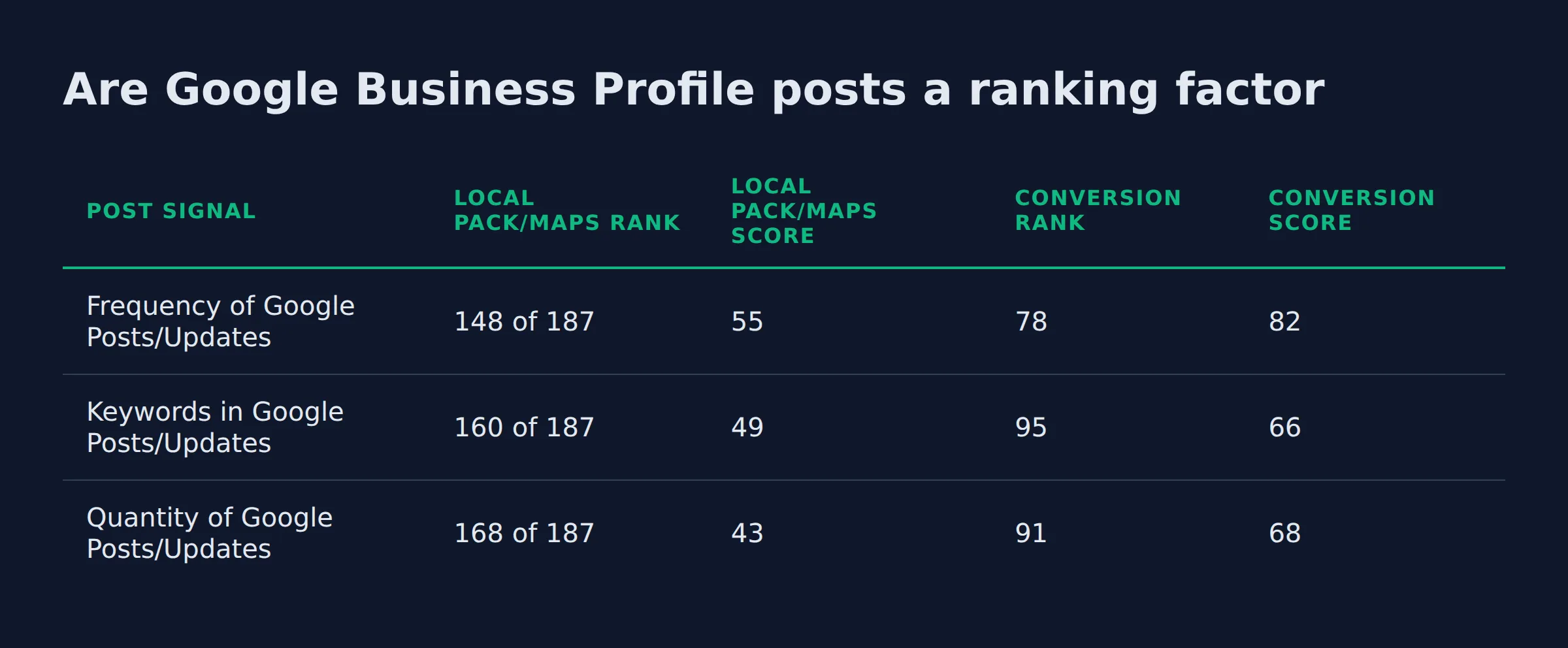
No. Whitespark’s 2026 survey scores post signals at the bottom of its local pack and Maps list, where the strongest post factor ranks 148th of 187. Google’s own ranking guide carries no post factor at all.
3 rows carry the whole argument. Every post signal lands in the bottom quarter of the local pack list, and the same signals score far higher on the conversion list.
| Post signal | Local pack/Maps rank | Local pack/Maps score | Conversion rank | Conversion score |
|---|---|---|---|---|
| Frequency of Google Posts/Updates | 148 of 187 | 55 | 78 | 82 |
| Keywords in Google Posts/Updates | 160 of 187 | 49 | 95 | 66 |
| Quantity of Google Posts/Updates | 168 of 187 | 43 | 91 | 68 |
Read the table by column. The top factor on the local pack list scores 227. The strongest post signal scores 55. That gap is the whole answer to this question.
Post signals do score higher on a different list. The same survey ranks post frequency 78th with 82 points on its conversion list, and the other 2 post factors climb there with it.
Every post signal ranks in the bottom quarter of the local pack list, against a top factor score of 227.
What does the evidence say about posts and map pack rankings?
Sterling Sky posted once a week for 9 weeks on 3 quiet listings and tracked 441 keywords per location. Local pack rankings did not move. The 2 apparent swings came from a shared-address filter and a job pack swap, not from the posts.
That test is small and 5 years old, and it is still the closest thing to a controlled experiment on this question. Joy Hawkins, who runs Sterling Sky and the Local Search Forum, ran the test. Two of the listings were service-area businesses and the third was a storefront. Her 3 listings carried no content, reputation, or link work. Any rank move would have come from the posting.
One listing dropped during the run. Hawkins found Google had filtered it because 2 profiles in the test shared the same address. The listing that replaced it had no posts tied to the tracked keywords at all.
The third listing bounced around. Her screenshots showed a job pack appearing and disappearing in the results, and the tracker read that as a decline.
Read the whole test at do Google posts impact ranking, including the comment thread where Hawkins answers the pushback.
Nine weeks of weekly posting across 441 tracked keywords per location moved nothing in the map pack.
Why do agencies still say posts help you rank?
Agencies push posts because posting is the easiest local SEO work to sell and to show. A finished post is a visible item on the profile, and a monthly report can point straight at it. Ranking work leaves no such item, so the posting calendar gets the credit.
We see the bill for this. Some profiles put the whole local SEO effort into posting, on top of a broad category and no review flow. The owner was told the posting was the ranking work, and the invoices matched the promise.
That pitch survives because the results look fine at first. The profile looks active. Views rise. The map pack does not change, and nobody in the report owns that column.
Most agencies billing for local SEO treat the profile as a publishing channel. It is a matching document first, where category, services, hours, and service area decide whether you appear at all.
Ask which column of the factor list a claim comes from. Ranking and conversion are scored separately.
If posts do not lift rankings, what do they lift?
Posts lift clicks, calls, and direction requests. They give customers a reason to act now. They also give you a surface for an offer, an event, or a service page.
A post earns its keep inside the profile, and the numbers stay modest. Joy Hawkins puts the average click-through rate on a post at 0.5 percent. In that same reply she calls posts a conversion tool.
What we see running profiles matches her number. A post buys something a photo upload cannot: a line of text a customer can act on. The posts that earn an inquiry carry a date or a service, like a same-week opening or a seasonal clean-up offer.
Announcements that only say the business exists earn views and nothing else. We stopped writing them for that reason.
When we open the performance tab with an owner, the pattern holds. Post views move, and the calls and direction requests follow the profile’s own buttons rather than the posting calendar.
A post earns attention from people already looking at your profile, and that is the job it does well.
How often should a service business post, and about what?
Post when you have something a customer would act on. A dated offer or a new service beats a generic greeting. Google’s own post flow lets you schedule a post and set it to repeat weekly, so a rhythm costs you no extra tooling.
Owners ask how often to post on Google Business Profile. The useful question is what the post is for. Frequency sits near the bottom of the local pack list, so a busy calendar earns very little. Cost is the other worry, and there is none. Google’s scheduling is free, so the only real spend is the time to write a post worth reading.
Posts are not the only channel inside the profile. Whitespark’s conversion list scores keywords in Google Q&A at 69 points, so a good answer carries weight too.
We post for owners when there is a real offer or a new service to announce, and we skip the quiet weeks. A monthly post tied to a real offer gets read. A weekly post about nothing gets scrolled past.
If posting is the first thing you plan to fix, start a step earlier. Learn to set up your Google Business Profile correctly first, because those fields decide who sees the post at all.
Post when you have a date, an offer, or a new service. Skip the filler weeks.
The 3-question post test we use
Run any post through 3 checks before you publish it. A post that fails all 3 earns nothing but views.
- It carries a date. An offer that ends Friday gives a customer a reason to move.
- It points at a page. A link to your service page sends the click somewhere useful.
- A customer can act on it. The reader knows what to do after reading it.
| What you have | Post it? | What it earns |
|---|---|---|
| An offer or an event with a date | Yes | Customers who act this week |
| A new service, or a page you want found | Yes, with a link | Clicks that land on your site |
| Photos from this week’s job | Yes, brief caption | Views inside the profile |
| A generic greeting | Skip it | Nothing a customer can act on |
This test is not a ranking tactic. It keeps the posts you publish worth a customer’s attention, which is all a post can earn.
If a post fails the 3 checks, it earns views and nothing else, and no posting schedule fixes that.
Related: Map Pack vs Organic Results: Local SEO Explained
Related: Do You Need a Website for a Google Business Profile?
Related: Local Service Website Pages That Rank on Google
FAQ
Do Google Business Profile posts expire after 7 days?
No. Posts older than 6 months are archived unless a date range is set, and that archive rule is the only expiry Google documents.
An offer or an event carries a date range, and Google keeps the post live until that date passes, per its post help page. The 7 day figure that circulates online shows up in blog comments, not in Google’s documentation.
Can posting on Google Business Profile get my profile suspended?
A post that breaks the content policy gets rejected or marked not approved, and Google shows the reason in the post’s own status.
Google also warns that a phone number pasted into a post description can get the post rejected, per its post help page. Keyword stuffing is the one post habit that scores as a risk. Whitespark’s negative and suspension-risk list puts it at 51 points, at rank 23.
How many posts should a service business publish each month?
No monthly number comes from Google. The quantity factor sits near the bottom of the local pack list, and a high count is not the lever.
In the profiles we audit, a monthly post tied to a real offer gets read, and a weekly post about nothing gets seen and forgotten.
Do I need a paid tool to schedule Google Business Profile posts?
No. Google’s post flow includes a schedule toggle and a repeat menu, so you can keep a rhythm on one profile without a subscription.
Sterling Sky’s 9 week test ran on a scheduling tool, DBA Platform, per the test write-up. A tool earns its fee when you are posting across many locations.
Do posts help me show up for a service I do not have a page for?
No. A post shows inside your profile. A service page is what competes for the search term.
Whitespark’s local organic list puts a dedicated page for each service first, at 210 points. Build the page for the service, then let a post point at it.
The straight read
Posting is the local SEO task you can hand to anyone, and it still gets sold as the thing that lifts rankings. The factor survey and the best test on the question both say otherwise.
Keep posting what helps a customer decide. Put the rest of your hours into the parts that decide who sees your profile at all.
If you want a straight read on where your Google visibility stands, a fifteen-minute call covers it. We open your profile and your performance tab with you and tell you what to fix first.