How to Ask Customers for Reviews Without Being Pushy
How to ask customers for reviews without being pushy: ask once at the right moment, keep the ask short, follow up once and stop. Plus the rules that bite.
You finished the job, and the customer said it looked great. Then you drove off without asking for the review. Most owners freeze at that exact moment.
Most advice on this topic comes from people who have never run a review ask on a real job site. This is the plain version.
Ask once, right after the job is finished. Make it about their experience instead of your rating, and send a one-tap review link. Keep the spoken ask under 10 seconds, then follow up once and stop. Ask every customer, including the ones you think will stay quiet.
TL;DR
- The ask rarely fails on wording. It fails on timing and length.
- Google removes reviews bought with an incentive or asked only from happy customers.
- The system is 1 short ask, then 1 reminder carrying the same link.
What actually makes a review request feel pushy?
An ask reads as pushy when it pressures the customer. Most of that pressure comes from the timing, and from leaving the customer no easy way to say no. Wording is rarely the problem.
You can ask customers for reviews. Google allows it. What turns the ask pushy is everything around it.
Reviews carry real weight. A clumsy ask costs more than no ask at all. BrightLocal’s consumer survey found that 97% of consumers read reviews for local businesses.
The pressure lives in the shape of the request. In the profiles we audit, most asks land 2 or 3 weeks late. That is well past the moment.
The customer has stopped thinking about the work by then. The owner sends a reminder anyway. The reminder is longer than the first message. Now the customer has to scroll and hunt for the link.
A late ask and a repeated ask do more damage than the words in the message.
Where the pushiest asks actually come from
The pushiest asks we see almost never come from the crew. When a technician or a crew member asks, the message is short. It happens in the moment.
When the office sends it, the message grows. It picks up a paragraph about reviews. Then it asks for 5 stars.
That last move breaks a policy. Google’s prohibited and restricted content page tells merchants not to request that specific content be included in a review.
Owners also fold the ask into an NPS-style follow-up, the survey score out of 10. Customers read that as a corporate process.
The longer the ask, the more it reads as a demand.
Where is the line between asking and gating?
Asking is allowed. Review gating is not. Gating means screening customers first, then asking only the ones you expect to rate you well.
The policy page is blunt about it. Merchants should not selectively solicit positive reviews, and they should not pressure anyone to leave a rating while on the premises.
Gating feels smart because it protects the star rating. It also puts the whole Google Business Profile at risk. That is a bad trade.
The profile has to be ready first. It has to be able to receive the review, so get the profile set up correctly first.
Ask every customer, including the ones who will rate you 3 stars.
What do you say when you ask in person at the end of a job?
Say it once, at the end of the walkthrough. Name something specific from the job. Keep it under 10 seconds, then text the link so they can do it later.
The review request script most owners need is 2 lines. “Glad the gutters came out clean. A quick Google review helps other folks find us. I’ll text you the link.”
That matters. Nothing gets handed over, and nobody waits while the customer types.
Owners report the same thing about that moment. The customer says yes. They mean it.
The ask stalls for one reason. The owner keeps talking past the yes and fills the silence with more detail.
Ask the person who signed off. A tenant can leave a review. The paying customer is the one with the story.
Most owners skip personalization. Naming the street or the job itself shows this message is for them. The timing question and the review count math sit in the sibling guide on when to ask and how many reviews you need.
A specific detail from the job beats a generic thank-you.
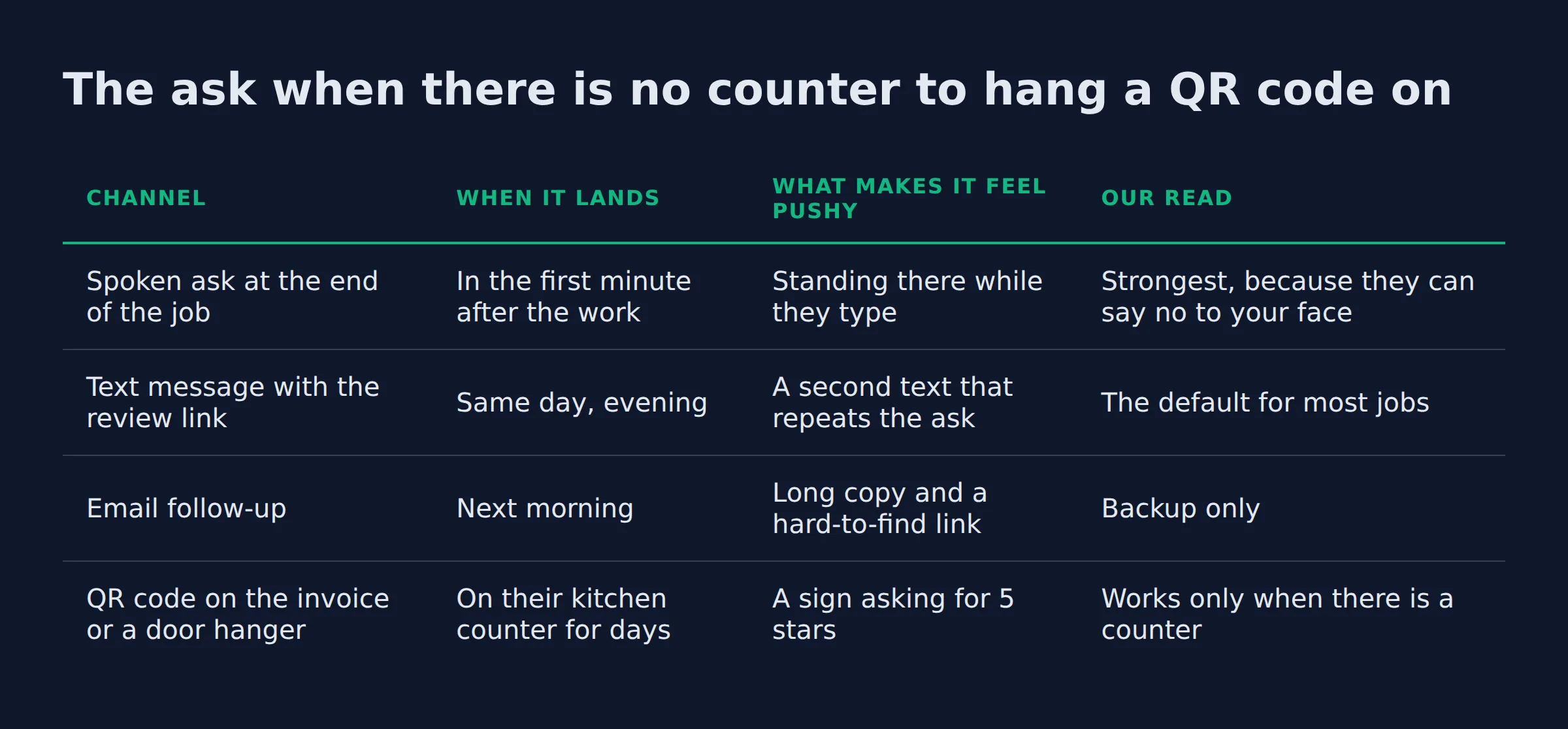
The ask when there is no counter to hang a QR code on
A service-area business has no counter. The review link travels by text instead.
Plenty of local trades work out of a truck or a van. Google’s own guide to create a review link or QR code has you generate the code on a desktop browser. Then you print it for a store.
Some trades have nowhere to hang it. A cleaner or a roofer who works only at customer homes has no storefront to point at.
| Channel | When it lands | What makes it feel pushy | Our read |
|---|---|---|---|
| Spoken ask at the end of the job | In the first minute after the work | Standing there while they type | Strongest, because they can say no to your face |
| Text message with the review link | Same day, evening | A second text that repeats the ask | The default for most jobs |
| Email follow-up | Next morning | Long copy and a hard-to-find link | Backup only |
| QR code on the invoice or a door hanger | On their kitchen counter for days | A sign asking for 5 stars | Works only when there is a counter |
The invoice is the one surface left. A QR code on the invoice works, but it is a slow path to a review. The text thread is faster, and the customer is already sitting in it.
A door hanger has the same problem. Most get recycled with the flyers.
Print the QR if you have a counter. If you do not, the text link is the whole system.
How do you follow up once without nagging?
Send 1 reminder 2 to 3 days later. Make it shorter than the first ask. If that gets nothing, stop. A third message turns a service relationship into a sales pitch.
A review request follow up is 1 message. Here is the whole thing. “Thanks again for having us out. If you have a minute, this link goes straight to our Google reviews.”
Review recency drives this. BrightLocal found that 74% of consumers only care about reviews from the last three months. A review from 2 years ago does not help the next searcher.
Email follow-ups land in a dead folder. A text follow-up lands in the thread where the customer already spoke to you. That is why the reminder belongs in the same channel as the ask.
Friction kills follow-ups. The reminder should carry the same short link. That link should open the review form directly.
The form shows the star row first. The box for words comes next. Most customers type 1 line. That is plenty.
Some customers rate you from the prompt inside the Google Maps app instead. That counts too.
Owners who quit on follow-ups usually quit for one reason. The second text felt rude to send. Our rule takes that judgment call away.
One prewritten reminder goes out on day 3. Then the system stops.
The reminder can be 1 line. It only has to carry the link.
What do you do when the customer says no, or says nothing?
Take the no and say thanks. Silence is also a no. Their experience still mattered, and a second ask does not change the answer.
The refusal costs 1 review. That is the whole bill.
The job probably went fine. Some people never leave reviews, and that holds across every trade.
If a customer does not leave a review, nothing is broken. The ask still worked. They were asked, and they passed.
If the no arrives as a complaint, that is a different job. Ask what went wrong and write it down. Fix what you can.
Reply once if it lands as a review. Keep it short. A calm owner reply does more for the next reader than a page of praise does.
Feedback beats a bad public review. A 2-question follow-up after the job catches a problem while it is still private. We ask owners to run that check before they ever ask for the rating.
A refusal costs 1 review. A second ask costs the relationship.
What should you never do when asking for reviews?
Two hard rules cover every banned move on this page. Never ask for a specific star rating, and never offer anything of value in exchange for a review. Never ask only the customers who will be kind. Never pressure anyone on the premises, and never set the crew a review quota.
The FTC made that second rule concrete. Its FTC rule on fake reviews came from a 5-0 Commission vote. Fake and incentivized reviews are banned, and civil penalties follow.
The rule is 16 CFR Part 465. It took effect 60 days after publication in the Federal Register.
Google’s contribution policy for Maps is narrower and just as hard. Merchants should not pressure users to leave a rating while they are on the premises, per the same policy page. Staff review quotas are named too.
So is it against Google’s rules to ask for reviews? No. The problem is paying for the review or filtering who gets asked.
| What you do | Allowed | What happens |
|---|---|---|
| Ask a happy customer for a review | Yes | Nothing |
| Ask every customer, happy or not | Yes | Nothing |
| Text the same review link to everyone | Yes | Nothing |
| Ask at the counter while the customer stands there | Only without pressure | Reviews removed |
| Offer a discount or a free add-on for a review | No | Review removed, plus civil penalties under the FTC rule |
| Ask only the customers you expect to rate you well | No | Reviews removed |
Ask everyone, and tie nothing of value to the review.
Why most owners stop asking after 2 months
Owners stop because the first batch came back flat. Flat reads as proof that customers do not leave reviews. It rarely is.
When we ask owners why they quit, the answer is almost always the same. They ran one batch. Then 1 review came back, and they called the channel dead.
The batch is what burned them. Review velocity gets blamed instead. In our experience, a steady trickle beats a burst followed by 6 quiet months.
The cost of quitting has gone up. BrightLocal’s research shows the share of consumers asking AI tools for local recommendations such as ChatGPT climbed from 6% to 45%. Google’s slice of review reading fell from 83% to 71% over the same period.
Those tools read a profile the way a person does. They look at the star rating and the review count. They look at review recency too.
Apple Maps and Trustpilot carry their own ratings for the same business. An empty profile looks thin there too.
The fix is a routine. The ask fires when a job closes, not when the owner remembers.
The one-ask test we run before any ask goes out
We run 3 checks first:
- Could this customer say no out loud, to your face, without it getting awkward?
- Would this ask still be fair if the job had gone badly?
- Does the ask survive 1 reminder, and no more?
Any no means the ask needs work.
A flat batch result says more about the batch than about your customers.
Related: How Google Ranks Local Businesses
Related: Why Am I Not Showing Up on Google Maps?
Related: Google Business Profile Categories for Service Businesses
FAQ
Can you ask customers for reviews?
Yes. Google allows a merchant to ask a customer for a review. The bans cover asking for a specific rating and paying for one. Asking only the customers who seem happy is banned too.
Is it against Google’s rules to ask for a review?
No. Asking is allowed. Google removes reviews when a merchant pressures customers on the premises. It also removes them when a merchant hands over an incentive or asks only the customers expected to rate them well.
How many times can you ask the same customer?
Once, plus 1 reminder. A third ask starts to feel like badgering, and it rarely gets the review. Save the energy for the next customer instead.
Is it okay to ask in person at the end of a job?
Yes, and for many jobs it works better than a text. Say it once and keep it short. Do not stand there while they type.
What do you do when a customer says they will leave one and never does?
Treat it as a no and stop. The promise was polite, and 1 more message rarely changes it. Ask the next customer instead.
At Local Biz Boost we set up the ask and the review link. We also set the reminder that carries it. The system should run on its own.
If you want a straight read on where your Google visibility stands, a 15-minute call covers it.